


This story originally appeared in Issue No. 01 of Southlands. You can escape your screen and dive into a print version of the story by ordering a copy in our shop. And be sure to subscribe to receive the next two issues.
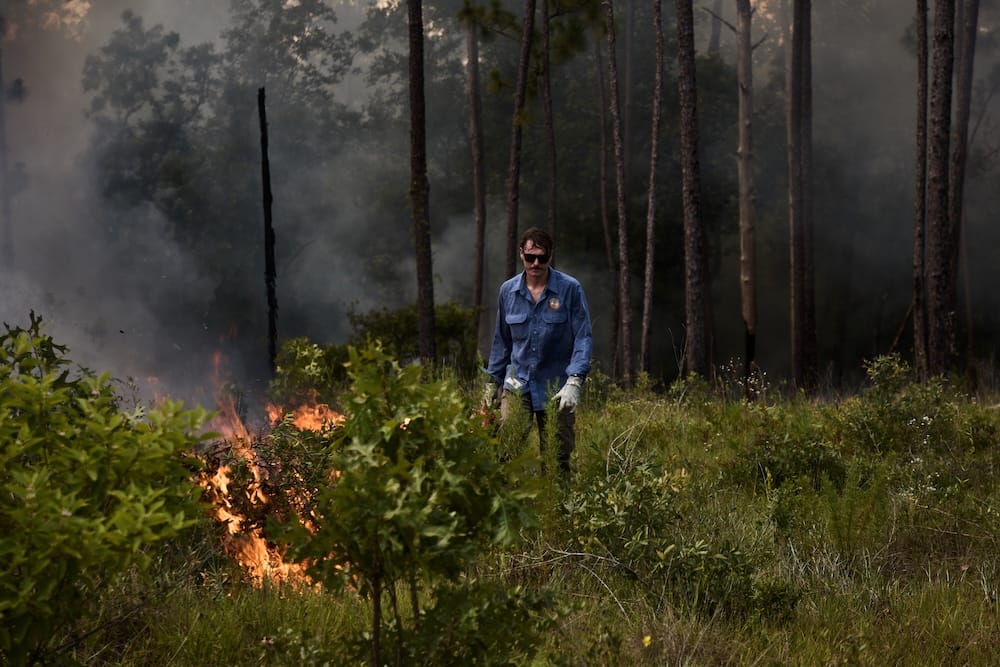
Two men step out of a white truck and pull a ramp from the back of its trailer. They’re standing halfway down a dirt driveway, an hour north of Tallahassee. Two more trucks pull in, carrying more members of their team. Out come three four-wheelers, two leafblowers, an armful of rakes, a chainsaw.
“Good job, nice,” George Jensen says to his partner, pointing at the neat rows of loblolly pines to his left. The forest floor between the trees is smooth and black, except where a bare twig pokes from the ash. “There’s not an ounce of scorch on those trees,” he says. “That’s a really, really good burn right there.”
Once, humans set fires across North America, from the woods of Connecticut to the prairies of Wisconsin. Then came colonization, the rise of Smokey Bear, and the suburbanization of the twentieth century. Now the Deep South stands apart: the place never quite stopped burning. In 2020, firelighters in the Southeast burned 6 million acres—while the rest of the country burned just half of that. Historian Stephen Pyne, a professor emeritus at Arizona State University and the country’s foremost chronicler of wildfire, has called the people of the Gulf “fire-steeped.”
Here, people light fire for all kinds of reasons: they want to attract game birds, or replant native longleaf pine, or they just like the way a forest looks after a fire has cleaned it out. Whatever their motivation, this burning starves out wildfires. Drive the length of I-10 in the spring, as I am: you’ll see plumes of smoke, ashy forests, and if you’re lucky, a creeping ground fire. The firelighters wear different hats: nonprofits, state governments, the feds, and private landowners. They are all inheritors of a tradition that goes back generations. Today, on a late spring day, I’ve come to meet the people passing it onto the next one. It’s a critical moment for the work. The rest of the U.S., scarred by a decade of megafires, wants to relearn controlled burning. The South is the hearth where they come for that education. But here, as across the U.S., it’s getting harder.
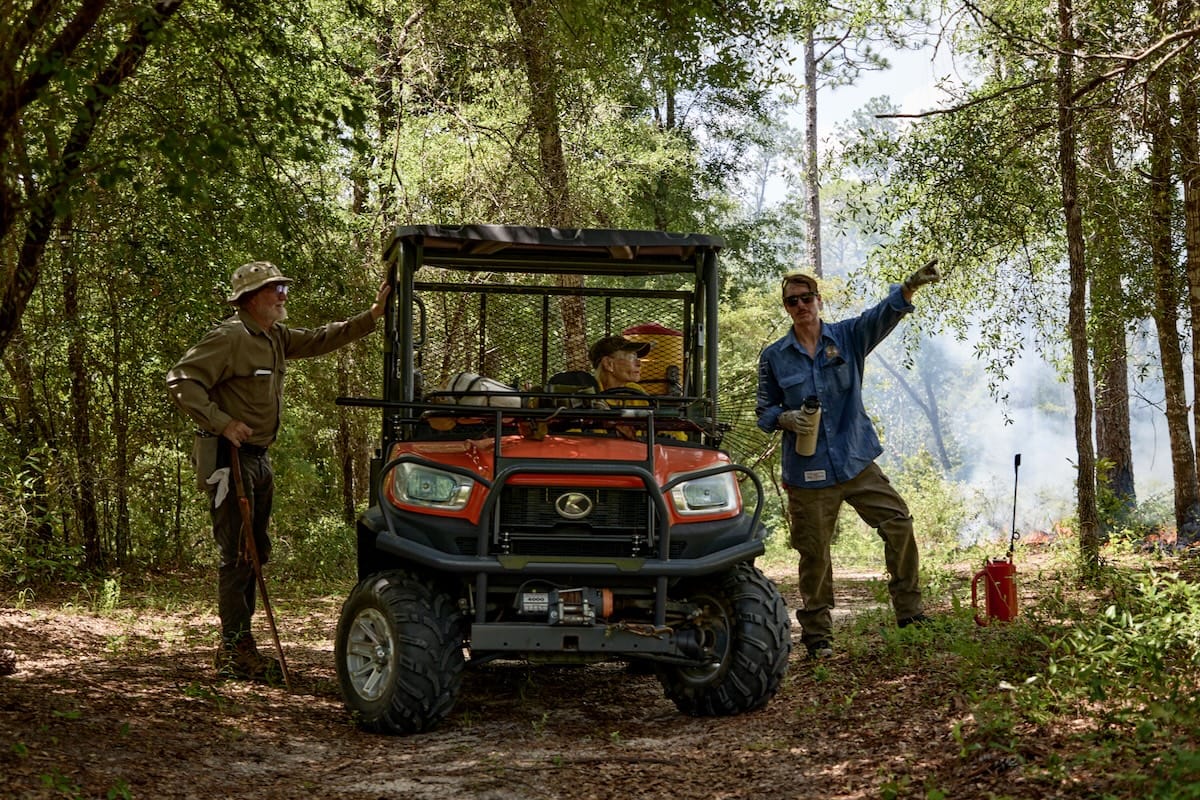
Still, if you want to learn to light prescribed fire, you come South. And so I called around looking for firelighters who might be open to hauling along a novice, which is how I found myself sitting in the passenger seat of this truck with Jensen and Stephen Wasp, both employees of Tall Timbers Research Station, a 4,000-acre preserve that is the cradle of managed fire science. Both men crisscross the South, helping landowners light their own woods. They wear matching fireproof Carhartt shirts. Wasp has a bandana around his neck, Jensen a bushy beard. Wasp is tall, though he has a way of leaning down amiably towards whoever’s talking to him. When they high-five, Jensen almost jumps up to meet Wasp’s hand. “I’ve burned with a lot of guys, and I like working with Steve best,” Jensen says to me.
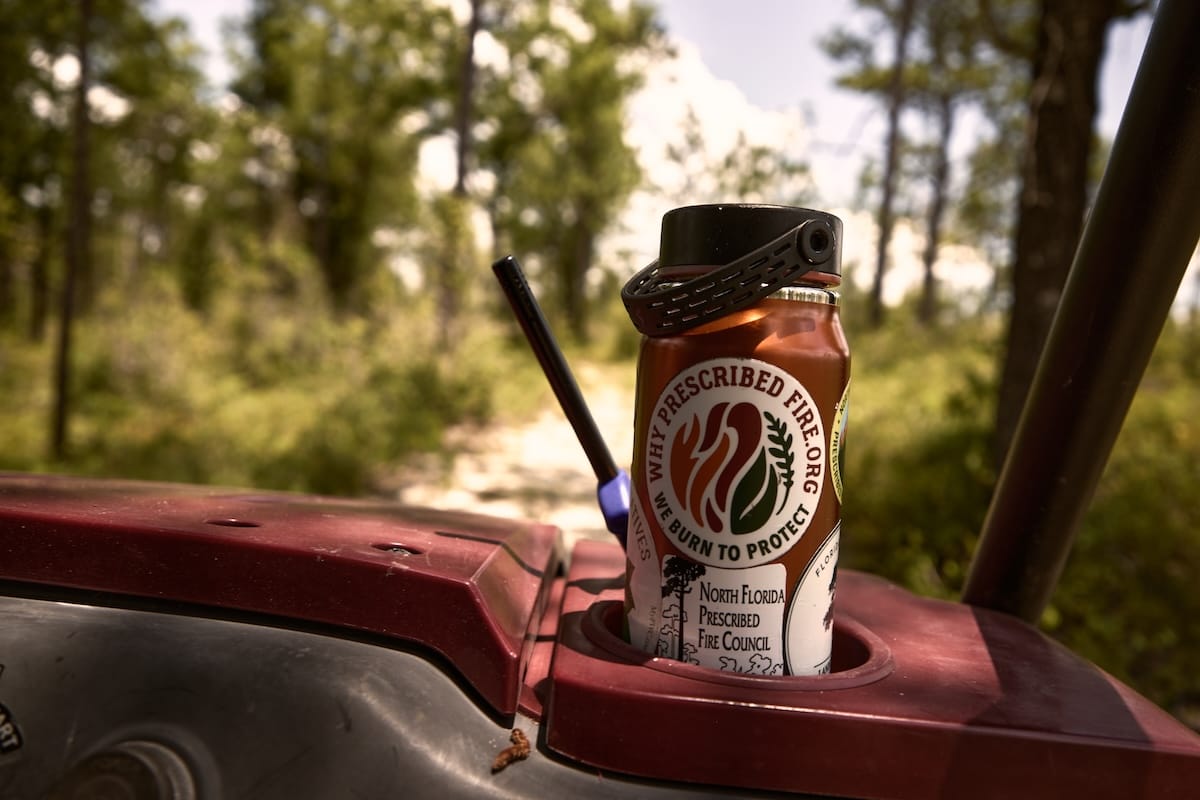
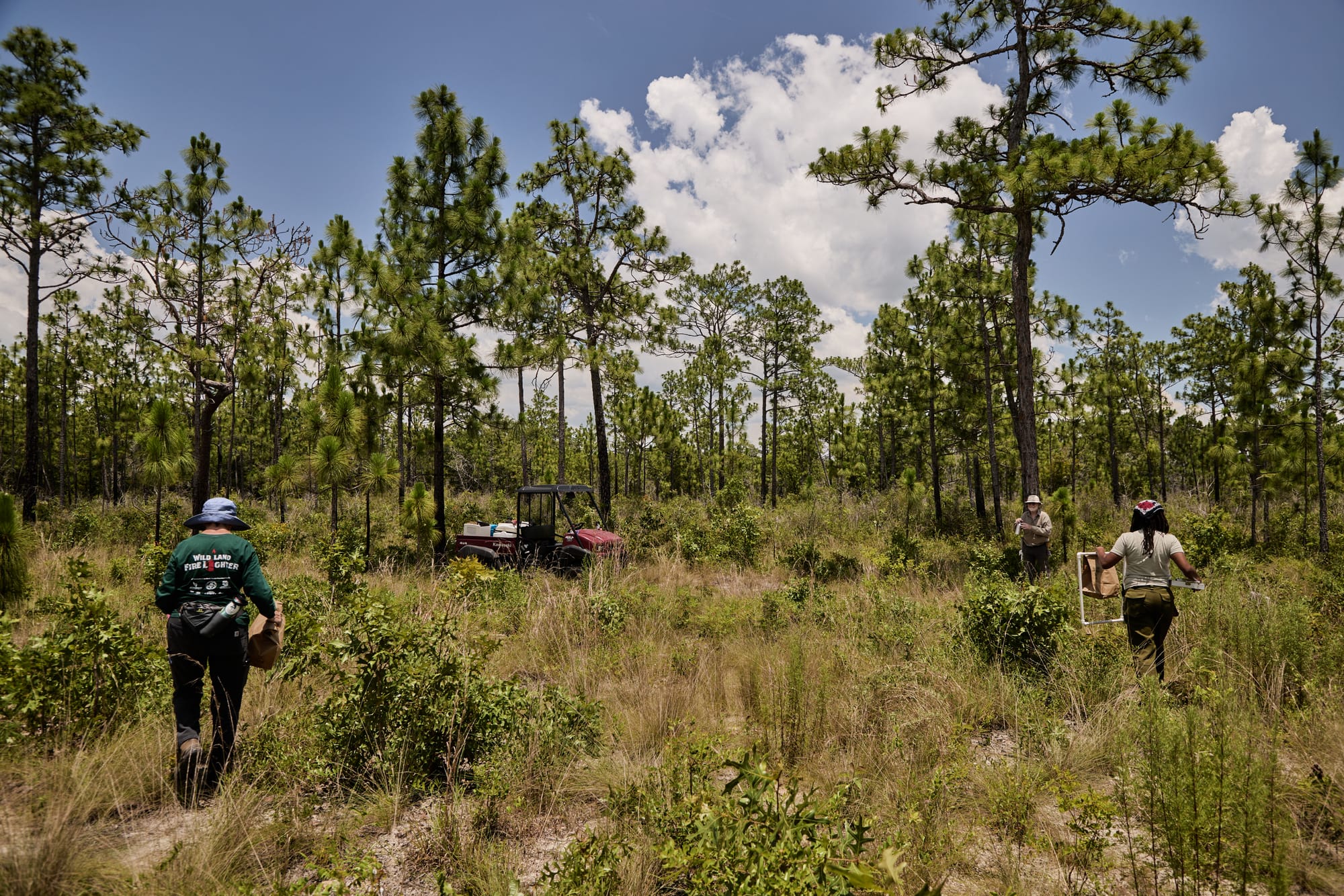
Their client today is Clifton Bailey, who is waiting beside his pickup truck further down the sand road. He’s a pulmonologist, and the burners call him Dr. Bud. He has a sharp jaw and a trimmed white beard and glasses that slide down his nose. He wears a safari hat with the brim buttoned on the sides. He owns these seven hundred acres with friends. The other four hunt—turkey and deer and quail. “I just manage,” Dr. Bud says. Usually he burns over the winter with two friends; the trio has an average age of seventy-five and a half. He’s draped in a stained yellow overshirt, the federal firefighting uniform. But up until now, he’s always burned during the wet winter months. He wants to learn how to set a summer fire, and so he’s called in reinforcements.
The cavalry includes two more Tall Timbers employees and the president of a group called the Southwest Georgia Prescribed Burn Association, which works just across the state line. Wasp—who has lit fires in the Rockies, New York, Delaware, and all over the South— is the burn boss for the day, responsible for securing the state smoke permit and overseeing the work.
There are 26 acres to burn, in a patch of loblolly pine forest shaped like a beech leaf. A sandy road divides the stand in half. The southern edge drops abruptly into a swamp. The morning winds will come out of the north, then out of the west by afternoon. Gauging humidity by feel—on the skin and in the mouth and on the plants—is a point of pride among prescribed burners. “If I had to guess, I’d say it’s mid-40s now,” Jensen says. It’ll drop below 40 percent over the course of the day—as close to desert as Florida gets—and the fire will burn faster, hotter.
Once upon a time, a cigar company cleared the pines from this stand to grow tobacco. In the ’60s, the fields were abandoned and became a pine plantation supplying a local plywood factory. The forest shows its wear: half-buried piles of logging slash, neat rows of pine, non-native grasses. Laurels and oaks have grown overhead in the years since it last burned. Today’s goal is to kill them off with what Dr. Bud calls a “clean fire,” one that leaves the pines above completely untouched. “We get a lot of microclimates in the trees”—spots where a fire could die off or smoulder for days. He points to the west: “This side’s bad. The hunters complain bitterly.”
Left unburned, a Southern pine forest becomes a jungle of oak shrubs, wait-a-minute vines, and wait-a-damn-minute thorns. Ecologists call the process forest succession. What the hunters want, Dr. Bud tells me, is a forest suspended at a certain moment in that cycle of growth: some shrubs to hide nests, plenty of grass and berries for food, but thin enough to walk through. “You’ve either got to mow it, herbicide it, or burn it,” he tells me. “Fire gives me another way to claw back the succession.”
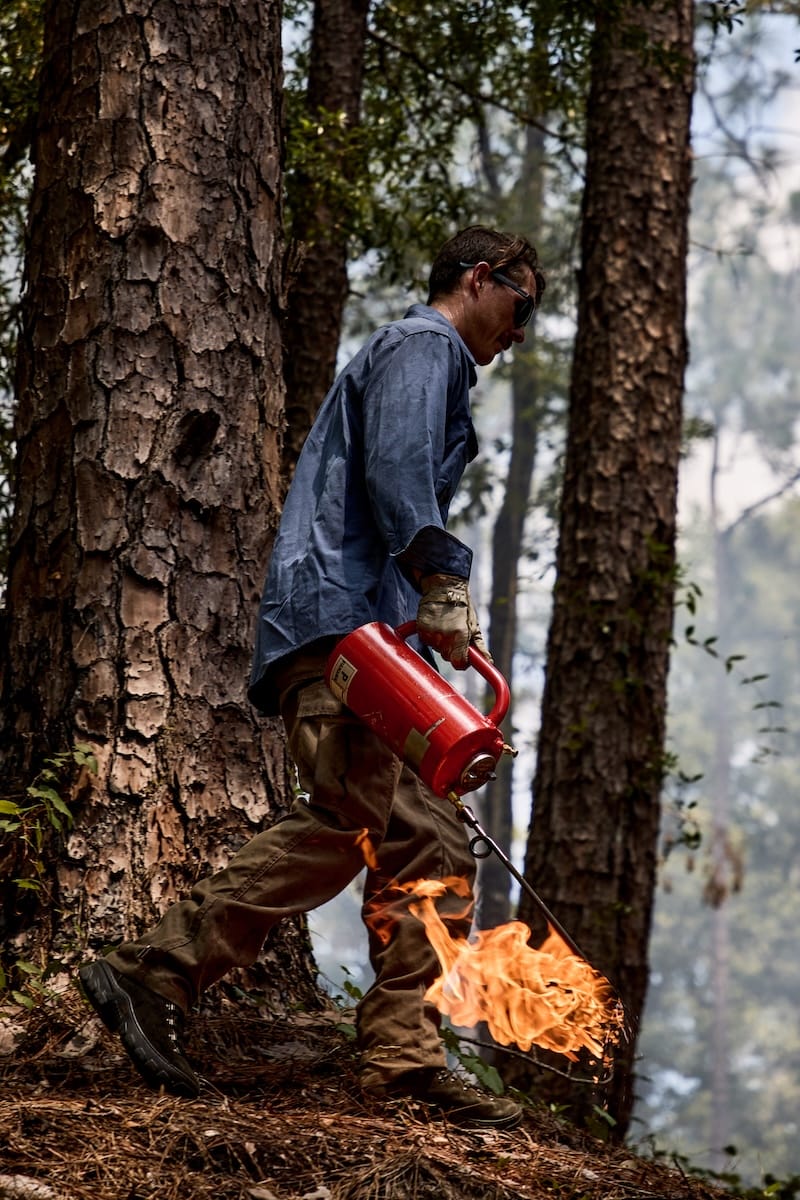
It’s traditional for the landowner to drop the first match. We gather in a meadow on the south end of the stand, and Dr. Bud takes a red drip torch in his left hand. The tool is a metal gas can with a looped neck. Tip it upside down, and a wick fills with fuel: two parts diesel and one part gasoline. “The gas makes it burn, and the diesel makes it stick,” Jensen explains. Light the wick, and you’ve got a watering can that shoots fire. Dr. Bud leans down and touches the torch to a clump of golden grass. It springs to life, dancing knee-high.
“Are you going to get any torch time?” the Georgia volunteer asks me with a raised eyebrow. His prescribed burn association has organized today’s burn. The association, coordinated by Tall Timbers, functions a bit like a mutual aid group for teaching fire. One member on their own might not have the necessary equipment or experience. Together, they do. And one of the keystones of the association is that everyone should get their hands dirty on a burn. So Jensen hands me a drip torch.
“Hold it like a gun and point it into the unit,” he says. “They will spit fire sometimes.”
Long before humans entered the picture, fire was just another kind of Gulf weather. Summer lightning sparked wildfires that tore across the landscape. Waves of fire killed back hardwood thickets, leaving a pine savannah that stretched across the Coastal Plains from Georgia to Texas. A savannah is somewhere halfway between meadow and forest; standing in one, you can see to the horizon through an endless curtain of trees. The native grasses and pines evolved not just to survive fire, but to encourage it. An old-growth forest here wants to burn. A fire creeping through wet grass will jump into the air when it hits a longleaf’s footlong needles. The waxy bushes of the understory “burn in dry weather as though doused in kerosene,” as one twentieth-century forester put it.
Indigenous people added their own fire— for hunting, to prepare farmland, and to keep the forest open for travel. Any given patch of woods was likely to burn every other year. Some burned in the first flush of early spring, and again in the heat of midsummer. Pyne suggests that the closest approximation to the old regime is at Eglin Air Force Basin, outside Pensacola, where ordinance testing sends fire washing over the landscape every year. The results were beautiful to the earliest European visitors: “Level green plains, thinly planted by nature with the most stately forest trees,” in the words of Philadelphian naturalist William Bartram, who visited in the 1770s.
This post is for subscribers only
Subscribe now and have access to all our stories, enjoy exclusive content and stay up to date with constant updates.
This is not a paywall
You can read this story for free, once you sign in.