

History: This site, used by a North American civilization between 3,500 and 3,200 years ago, lay undetected until the 1830s. Designated a National Historic Landmark in 1962, a U.S. National Monument in 1988, and the country’s twenty-second UNESCO World Heritage Site in 2014. The name comes from a nineteenth-century plantation situated on the site.
Geology: Shaped by the nearby Mississippi River, with a flat, floodplain topography. Alluvial deposits of silt, clay, and sand coalesce into a productive soil. Innumerable spearheads, figurines, and other artifacts fashioned from rocks are notable because none of these rocks are native to the site, and would have been imported from hundreds of miles away.
Ecology: A mixture of bottomland hardwood forest and pines, fragmented by fields and incised by Bayou Maҫon—all a short distance from the main-stem Mississippi River. The present-day region is dominated by agriculture; ancient civilizations relied on resources hunted or gathered from the natural ecosystem.
How people use it: The original inhabitants likely used Poverty Point as a market or gathering place. Today, visitors can hike miles of the earthen mounds and ridges, visit artifacts at the interpretive museum, and participate in ancient demonstrations, such as hurling an atlatl, the hunting spear that predates the bow and arrow.
I knew I didn’t miss a turn, but surely this was not the destination.
Louisiana State Highway 577 promised to deposit me at a UNESCO World Heritage Site, yet the fields here looked no different from anything I’d seen in the previous two hours. Clean, low-cut grass in all directions, with a horizon of mingling hackberry, water oak, and green ash trees: pleasing enough, but mostly it prompted me to think about how I’d justify the long drive to my six and eight-year-old daughters. Could that distant hill—an inconspicuous lump under the floodplain rug—be the thing we came to see?
A stately wooden sign confirmed that we had reached Poverty Point. In front of us lay a cultural site that was contemporary with the Ancient Egyptians, the Shang Dynasty in China, and the Maya of Mesoamerica—all recognized by the U.N. as globally important. We were squinting at a field that is on the Earth’s resume.
In a country where “old” means the 20th century and “colonial” feels like the Stone Age, Poverty Point’s architecture—from an era the archeologists formally describe as the Archaic—can feel more alien than ancient. Indeed, you can find YouTube videos explaining the site’s extraterrestrial origins, and its eroded features create enough distance from modern-day life that it’s not hard to see why conspiracy theorists enjoy this place. We head to the visitor’s center first, not knowing otherwise how we might start this experience, where we collect maps and pretend to know more about the site than we do.
Once you encourage your imagination to animate the site, you begin to think about North America in old, fresh ways.
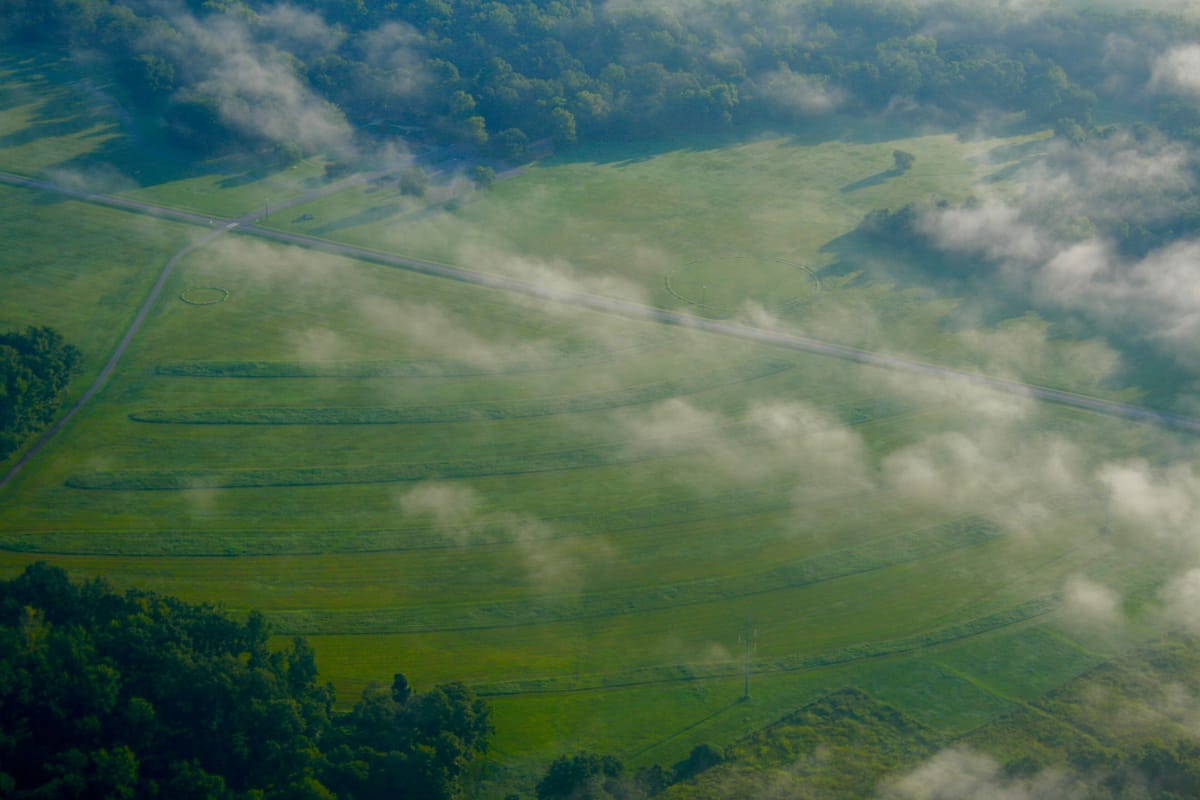
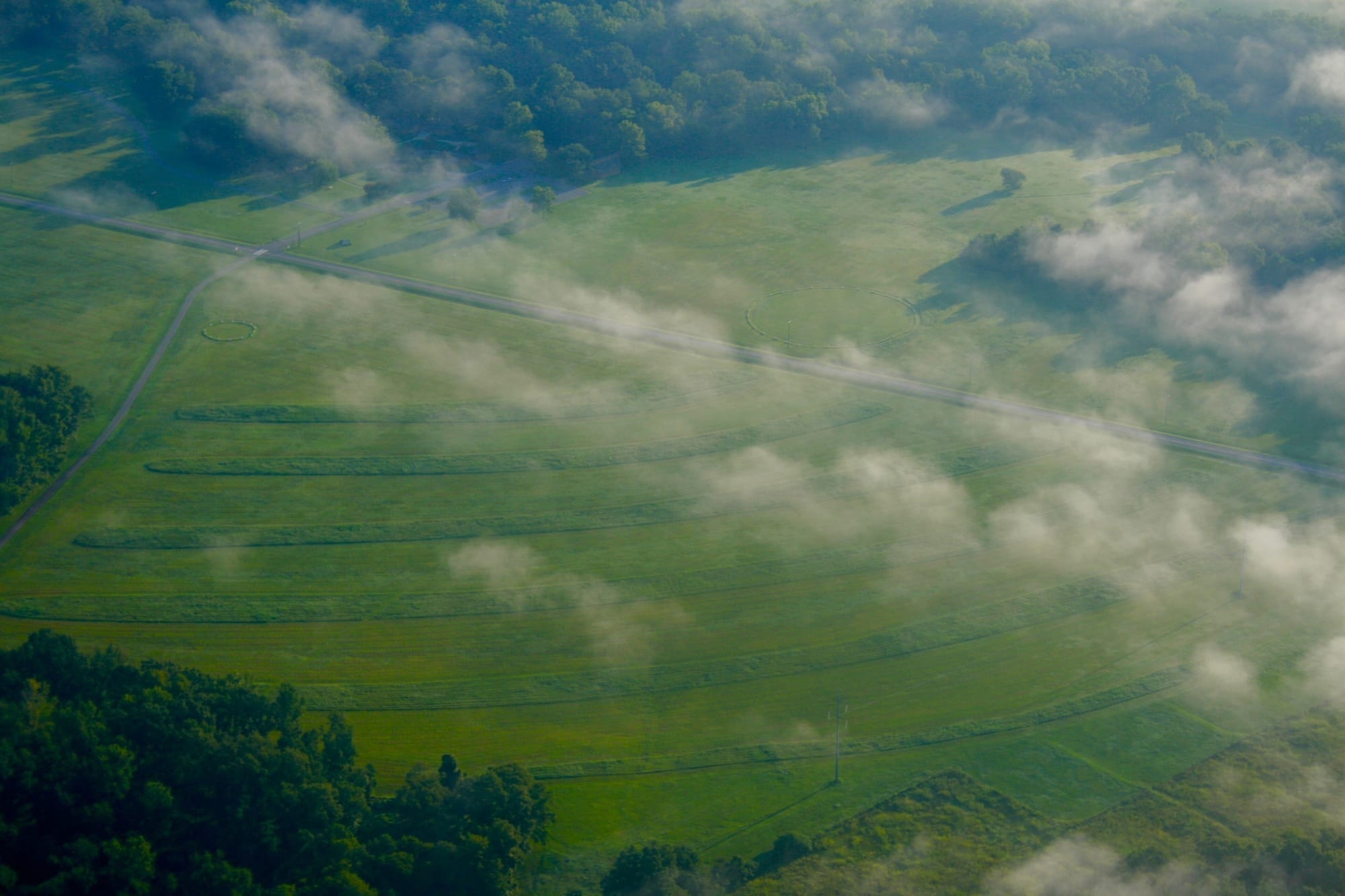
We explore a series of six concentric ridges that abut Bayou Maçon, the site’s winding eastern perimeter. The earthen ridges are only a few feet high, but run close to a mile in length. The bumps are like stars: individually notable, but more impressive when viewed together, like a constellation. Overhead, they resemble a rainbow, its feet stopped by the bayou. They look like the crop circles that set off stories of UFOs in the 1970s, except shaped into a rainbow arc rather than concentric rings. The ridges are thought to have been a settlement or market area, an assumption supported by the thousands of artifacts found in and around them, including small pot-belly owls and clay squares. Though archaeologists have begun to shed light on the lives of the original peoples, mysteries still permeate their customs, rituals, and roles.
At the crown of the rainbow of ridges, just outside the outermost ring, we ascend a boardwalk up Mound A. It’s a 72-foot-tall, flat-topped, carefully constructed earthwork also known as Bird Mound, owing to its bird-like shape when viewed from above (but which, to my eye, given the erosion that has worn away some details, better resembles a human molar). Archaeologists estimate that Mound A was built in ninety days or less, no small task for something that would require thirty thousand dump-truck loads of earth. I wonder if the Department of Natural Resources could accomplish such a feat in the same amount of time?
We crest Mound A, and despite trees obstructing a clear view, the scene is coming together. Perhaps this mound was used for ceremonies or rituals. Or as some type of elevated position from which to view the activities that took place on the ridges below. A flood of questions washed over me: Why was this thing built? What were the inhabitants doing down below? Was this gathering site the Hartsfield-Jackson Atlanta International Airport of the Late Bronze Age?
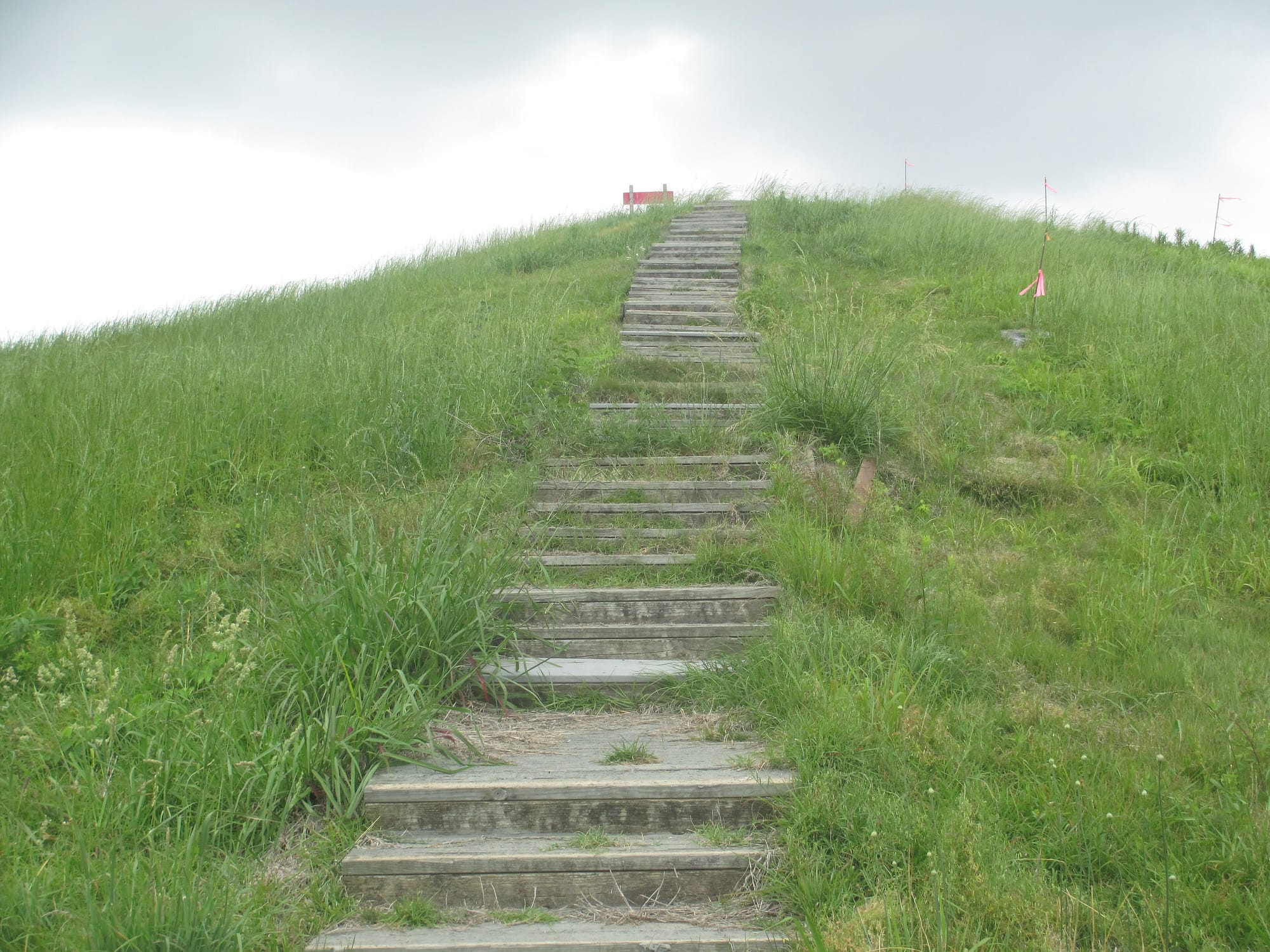
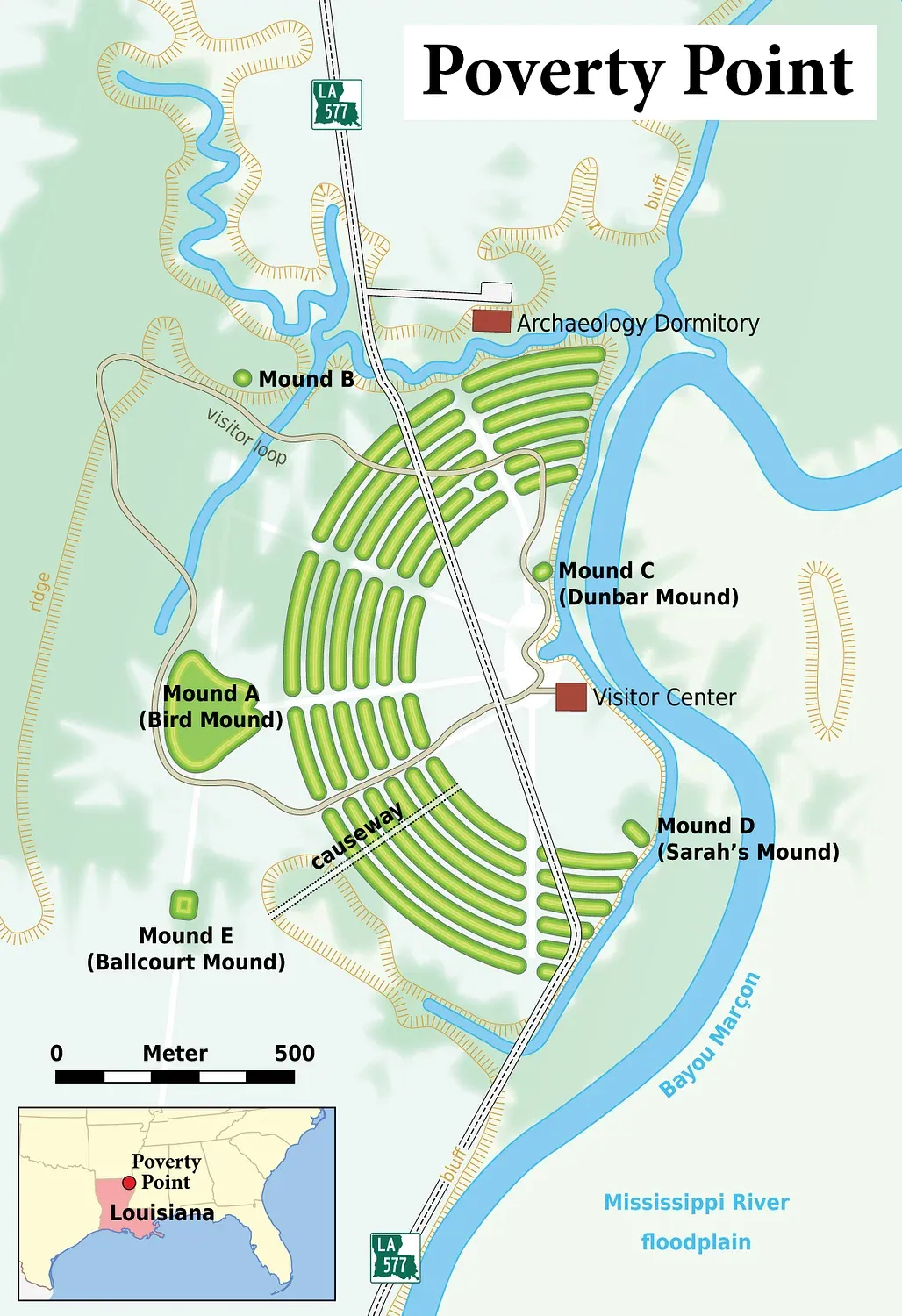
Steps up to Mound A (Billy Hathorn); map of Poverty Point (Maximilian Dörrbecker)
A visit to Poverty Point is an experience unlike any in the U.S., much less the South, not a place typically associated with ancient civilizations. The mounds and ridges are regular enough to give visitors a dim intuition that they are not natural features, yet these piles of earth are far enough removed from our concepts of architecture that one can understand how they were overlooked for centuries. However, once you encourage your imagination to animate the site, you begin to think about North America in old, fresh ways.
When we imagine the history of the South, it’s not hard to picture plantations, or maybe even Spanish conquistadors, but as the years spool backwards, the imagery dims. Most of us assume something was happening here before wooden ships crested the eastern horizon, but we have few tangible glimpses into an authentic southern life at the time the Egyptian pyramids were being built. Despite the South’s rich cultural heritage, what archeologists have managed to piece together has, sadly, not yet made it into many grade school textbooks.
A trip to Poverty Point might not hold the majesty of the Great Smoky Mountains or the tranquility of a Lowcountry salt marsh, but it challenges our notion of “land” in important ways. Land is not something that always devolves from wilderness to clear-cut to strip mall. It often has an invisible past we cannot fully know. Fields, forests, and even wilderness have been touched and shaped by humans, regardless of what we think of a place now. The irony is that the less a people abuse the land, the less trace they’ll leave. The hunters and gatherers at Poverty Point may be just the people we need to learn from, but that itself makes it hard to learn from them.
Steve Midway is a writer and scientist in Baton Rouge, Louisiana. He is a professor at Louisiana State University and Editor-in-Chief of Transactions of the American Fisheries Society.