
Hummingbirds fascinated Spanish explorers in the Americas. They called them “joyas voladoras,” which means flying jewels—an apt name for the tiny, vibrantly hued creatures with quirky flying patterns.
I picked up this trivia while enjoying an essay by the late writer Brian Doyle at a Comfort Inn in Harrisonburg, Virginia, on day thirteen of a fifteen-day fishing trip through the Appalachian Mountains. The morning after my late-night reading, I drove into the mountains to fish an insubstantial stream that trickles through the George Washington National Forest just west of Shenandoah National Park. The Skidmore Fork alternates between placid stretches and gentle riffles and never reaches a width of more than fifteen feet. Deadfall chokes the creek, blocking my way as I crept upstream to sneak up on the fish.
Wild brookies, the only trout native to the eastern United States, are also the only trout you’re likely to find in this creek. Imported rainbows and browns haven’t invaded the Skidmore Fork and muscled out brook trout as they have in almost all of the lower-elevation, less-remote streams in the Appalachian Mountains. Anglers often must bushwhack their way through dense rhododendron bushes and clamber up steep mountain paths to reach the few remaining brook trout refuges. The difficulty of finding brookies lends the fish a cachet denied other Appalachian trout.
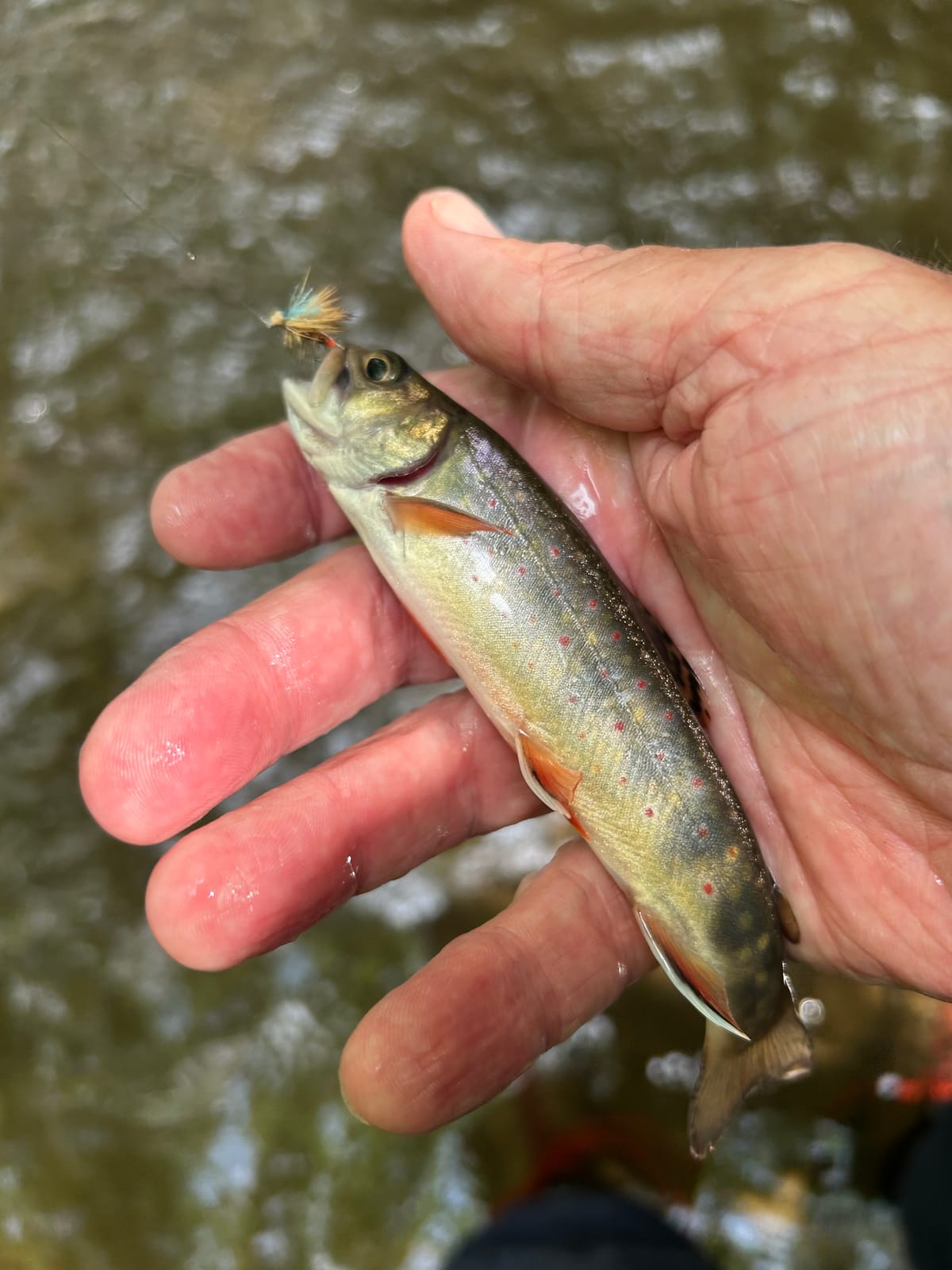
When I caught my first brook trout on the Skidmore, I cradled it in my hand and thought of the Spanish explorers’ affectionate term for hummingbirds—joyas voladoras. It suddenly came to me: brook trout are to fish what hummingbirds are to birds. The parallels can’t be ignored.
Like hummingbirds, wild mountain brookies are miniature; none of the dozen or so I caught exceeded six or seven inches. Just as hummingbirds seemingly defy aerial physics by moving vertically or remaining stationary, brook trout demonstrate shocking swimming prowess in those rare moments when they can be observed. If the water is still and the surface is unruffled, a brookie can be detected via a shadow that darts remarkably fast and abruptly turns to move in another direction.
The difficulty of finding brookies lends the fish a cachet denied other Appalachian trout.
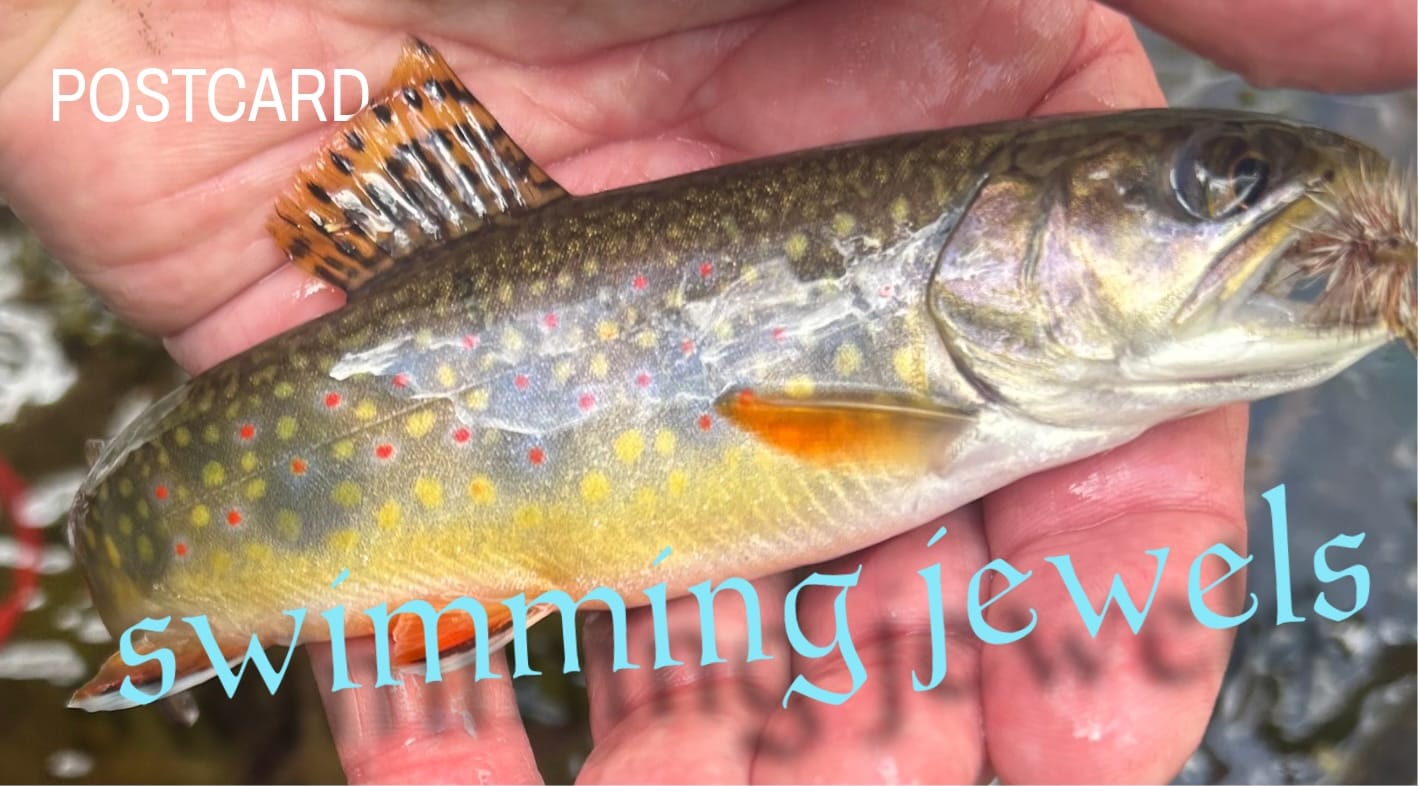
It’s colors that inspired the Spanish to call hummingbirds jewels, with varied species exhibiting all offerings of the rainbow. Likewise, brook trout show out with buttery undersides, orange fins and yellow and red spots haloed in white against green sides. Both are multi-colored gems.
I threw floating flies half the size of an index fingernail at the brookies.The faux insects whirled in eddies or skittered downstream on riffles. If I was lucky, the flies disappeared in a commotion and a trout tugged my line. Don’t be fooled by their size; the feisty brookies shot downstream or zigzagged from one side of the creek to the other in an unsuccessful attempt to escape.
There’s a breed of fly anglers who focus on mountain brook trout—preferring the wild, native fish, no matter how miniature, to their much larger rainbow and brown cousins. The hardcore among them scan topographic maps of Appalachian Mountains, searching for “blue lines” denoting obscure, skinny creeks in the high altitudes where the elusive brookie hold out. Big browns and rainbows don’t capture the fancy of these specialized anglers, who dismiss them as interlopers that were introduced to the region or—gasp!—may have been born in a hatchery.
Those fishermen live in an atmosphere too rarefied for me. I’m proud of the two eighteen-inch rainbows that I caught on this trip, one from the Ravens Fork in North Carolina and the other from Beaver Creek, a short drive from the Skidmore. Still, the vivid hues of these brook trout and their survival skills in a hostile world endear them to me out of proportion to their length.
If hummingbirds warrant a lyrical Spanish nickname for their madcap behavior and beauty, the same can be said of Appalachian brookies. I christen these elusive fish “joyas nadadores”—swimming jewels.
Mike Tapscott is a retired lawyer in Tupelo, Mississippi, who has finally achieved his goal of spending more time in a trout stream than in a courtroom. (In retirement, he's also completed his wish list of visiting every Major League Baseball park.) He's a former journalist who writes fly fishing essays for outdoor publications.