



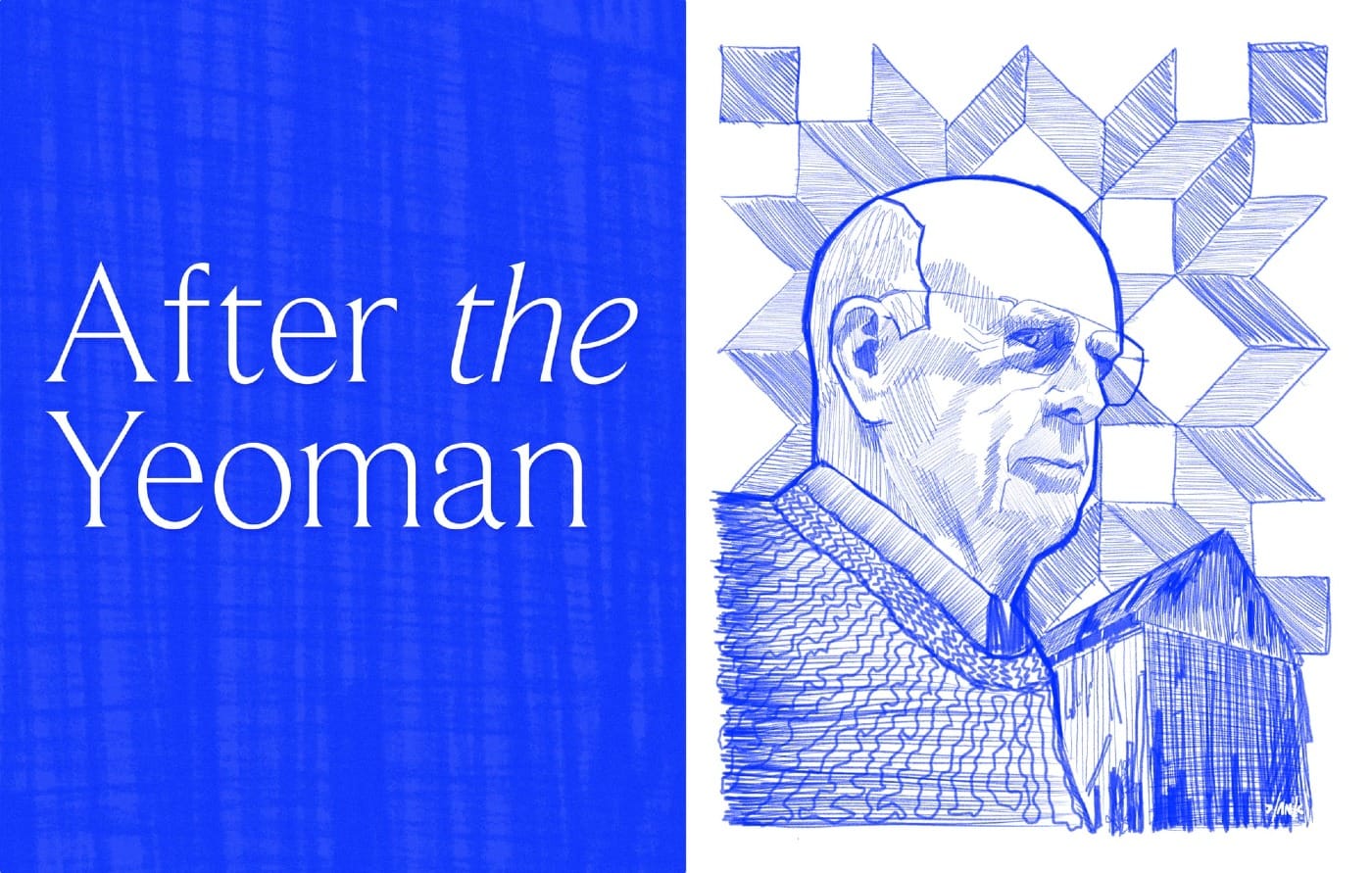

“In the natural environment, everything had its place, including humans. In that environment, everything was likely to be shaped by the reality of mystery. There dominator culture (the system of imperialist white supremacist capitalist patriarchy) could not wield absolute power. For in that world, nature was more powerful.”
—bell hooks, Belonging

Wendell Berry hovers over the South. The Kentucky writer occupies an enigmatic space for many of us who grew up a generation or two removed from the land, pushed out or drawn away by modernization, mechanization, and conglomeration.
My own great-grandparents were chicken, cattle, and vegetable farmers in the rural Ozarks; my grandfather was a USDA inspector. My parents live “in town,” though still on enough land for a few cattle and a barn. Berry’s work hits squarely at my family history: he speaks to the loss of a heritage people like me can feel we are a part of even if we have engaged it not through actively working the land, but by walking through the falling-down buildings, rusted tin metal barns, and fallow fields of our forebears, listening to their stories and recording their histories. Berry points to a sense we feel that something existed once and has been lost; he writes from a place of living, leaving, and returning. He knows what it’s like to have left in search of education, opportunity, urbanity, modernity, and—crucially—to come back, to insist on a life in deep relationship with one’s land and the community surrounding it. In setting such an example, he challenges those, like me, who have chosen different lives.
He is also ninety years old, a product of a different time. His critics charge him with provincialism, Ludditism, nostalgia. When Southlands asked me to reflect on Berry and his influence, I found myself contemplating: What does Berry’s body of work have to offer us now?
Though his fiction and poetry are beloved, it’s Berry’s writing on agrarianism—its idealization of small farmers, in rural locales, and deep connections to the land—that has held a quixotic, aspirational influence over many Southerners. And his earliest such work—The Unsettling of America, The Hidden Wound, The Long-Legged House—is his best, full of rage and careful thought. Writing in the 1960s and 70s, he was able to look at himself and his society with remarkable honesty. He saw that settler colonialism resulted not just in Indigenous genocide and exploitation, but in a remarkable distance between white people and the land surrounding them:
The white man, preoccupied with the abstractions of the economic exploitation and ownership of the land, necessarily has lived on the country as a destructive force, an ecological catastrophe, because he assigned the hand labor, and in that the possibility of intimate knowledge of the land, to a people he considered racially inferior; in thus debasing labor, he destroyed the possibility of a meaningful contact with the earth. He was literally blinded by his presuppositions and prejudices.
There is more than a touch of Marxism in his work: the profit motives of industrial capitalism further alienated the dominant white society from the land, he wrote, and from the rhythms of nature and ecology, and from work itself—alienation that has become the root of white culture. In The Unsettling of America, perhaps the most well-known and prescient of his works, he called this alienation “an evil that is not merely contemporary or ‘modern,’ but one that is as old in America as the white man’s presence here.” Industrialized agribusiness and the USDA take the brunt of his ire: “corporate totalitarianism” over farmland means that the land becomes overused, its nutrients exhausted; land is bought up by corporations, the work mechanized, rural people displaced into cities; the practices of husbandry and close relationship to land and to what grows on it—animals and plants—are lost. White settlers, by embracing industrial capitalism and industrialized agriculture, became the destroyers of our own communities.
What is striking about reading Berry now is the extent to which the world he predicted has come to pass, the alienations and displacements, the ecological crises and the communal ruptures. The battles have been lost. Agribusiness won: we are living in the world it created and destroyed. If it falls, I fear it will be because of its own destructive impulse, not because of any organized movement against it. Once prophetic, Berry’s essays now feel like a statement of our present, Isaiah’s prophecies of the Messiah read after Christ has been crucified.
So what, then, comes next? Here, I find Berry less useful. His own answer—to return to the farm and live on it, practicing a localized and personal agrarian politics, building community around the land and our lives on it—feels both too small and too far out of reach. How many of us could afford to buy a small plot of land, could afford to move our families and lives to it, could afford to invest the time and resources needed to make soil and ground so exploited and contaminated whole again? Let’s assume that we want to build self-sufficient rural communities. Can thousands of little hammers knock down the walls of outside ownership, monocropping, pollution, and rapidly shifting climate and terrain? There are vast structural changes that are necessary for that to happen. How can we get there?
Once prophetic, Berry's essays now feel like a statement of our present, Isaiah's prophecies of the Messiah read after Christ has been crucified
Reading Berry brings a mixture of deep agreement and deep discomfort. There is a sense of assuredness and, at times, self-righteousness that is present in Berry’s recent work and in the work of many of those who take him seriously. Some of the same publications that have been most sympathetic to Berry and his vision of community-centered agrarianism have also embraced elements of Trumpism and trad-Catholicism—movements at odds with not just my own politics and Christian beliefs, but with the most radical, promising versions of Berry’s own thought. In his success at putting the small yeoman farmer in the genealogy of industrial capitalism’s many victims, Berry’s framework sometimes suggests that this yeoman struggle against industrial agriculture and industrial capitalism is a struggle on equal planes, if not more important than, other struggles and other exploiters. In Unsettling, he writes that the subjugation of Indigenous peoples imposed “substantially the same catastrophe upon the small farms and the farm communities, upon the shops of small local tradesmen of all sorts, upon the workshops of independent craftsmen, and upon the households of citizens” as upon the Indigenous people themselves. Can this really be true?
I write this in a South and a world faltering in the face of authoritarianism, genocide, and climate catastrophes. Just a few weeks ago, ICE entered the courthouse in Charlottesville, where I now live, and stole away two people; they’re threatening to prosecute the community members who attempted to intervene. Tornadoes, hurricanes, floods, and wildfires have touched almost everyone I know in this region. But climate change and structural global inequities are also driving refugees to these places, often to work in the industries Berry is most concerned with: large-scale industrial agriculture, factory farming, and food processing. The wreckage of industrial capitalism is all around us. Doesn’t that require us to envision a different future that is not just a restoration of a presumed agrarian past?
The greatest victim of settler colonialism, agrarian writers sometimes seem to argue, was the settlers. Even if Berry himself does not think this, his position as the dean of agrarian writers—the crank of all cranks, a person of charity and character—has privileged his own position as the emblematic white yeoman farmer against the forces of modernity. Berry is honest about who he is and who he is not, a position that allows him—like his philosophy—to be both small and large, to sit in the local but speak to the global in its critiques of the intimate consequences for people, land, and community that multinational industrialized agribusiness has wrought. The consequence of this, given Berry’s vaunted and central place in writing and thinking about rural and agrarian America, has been to privilege the plight of the small, assumed white farmer over and above the distinct though related struggles of others who, sometimes by choice but more often by force and coercion, have also made homes, communities, and lives in the rural South.
“Were Berry a student of my work, I would encourage him to think more about the ideology of white supremacy,” the Kentucky writer bell hooks says in Belonging, her underappreciated collection of essays on leaving and returning to rural Kentucky. The book includes a transcript of a conversation with Berry; to introduce that discussion, hooks notes that while our society has worked to rid itself of the most obvious signs of racial inequality, there is, in Western metaphysics, an emphasis on dualism that has been harder to remove: nature versus the human, white versus Black. It’s this dualism that gives white supremacist thinking its foundation, hooks says.
Berry's answers—to return to the farm and live on it, practicing a localized and personal agrarian politics, building community around the land and our lives on it—feels both too small and too far out of reach.
We all write within intellectual and political traditions with which we disagree, building on old ideas and, ideally, tearing down those we find noxious to build anew. But Berry is too often unable to escape his intellectual predecessors, men like John Crowe Ransom, Allen Tate, John Gould Fletcher—essayists, poets, and novelists who were by disposition conservative, many of them deeply subsumed in veneration of the old Confederacy. Even some Marxist thinkers in this tradition came to regard the South’s chattel slavery as something more like feudalism than capitalism and therefore preferable to the modern industries that were, by Berry’s era, ravaging the Southern landscape. At the root of this genealogy is, of course, Thomas Jefferson, a slaveholder who dared to write of democratic citizenship.
Perhaps I feel Jefferson’s contradictions, and Berry’s frequent invocations of him as a consummate democrat, particularly offensive because I now live in Charlottesville, in the shadow of Jefferson’s plantation, as a member of “Jefferson’s university”—a place built and staffed by enslaved workers. Jefferson’s descriptions of yeoman farming—a tradition he did not himself participate in—became a credo for many whose particular ancestries and positionalities have not forced them to confront the bondage and cruelties endured by those who were doing the work with which Jefferson is often credited. Every vision of the future rests on some understanding of the past, but these thinkers provide a brittle structure.
The dominant vision of the South, built on the influence of this white agrarian writing, has too closely bounded its intellectual windows; in its insistence on local, communal ways of life and dialogue, it fails to open itself up to other intellectual and political genealogies. Berry has gone to greater lengths than most others writing in this tradition to pull himself out of such closedness, but his more recent work makes clear that even he has not fully been able to escape. This is why the version of Southern history Berry offers in his recent book, The Need to Be Whole, fails so dramatically—dramatically enough that I had to put the book down partway through because, as Daegan Miller wrote in his review for Slate, it presents “a revisionist history of slavery and its legacy that is largely unburdened by historical fact, laced with resentment about verbal slights flung at both the South and the rural U.S., and utterly incurious as to why, for instance, masses of Americans might find statues of Confederate generals objectionable and so be inspired to pull them down.” We can trace this failure of imagination and curiosity back to Berry’s intellectual canon, generations of writers who accepted the Old South’s Lost Cause mythology.
This genealogy of agrarian writers considers slavery and race as secondary to class—the idea that it is economic subjugation that must be considered first, racial subjugation second. But we know as Southerners that the ways we interact with the landscape are continually, forcefully, marked by race. Thoughtful scholars have long since come to understand that modern capitalism is inherently racialized—that we cannot separate an analysis of our economic landscape from its social and cultural politics. And for analyses of the world as it is today, the world as perhaps it always was, we must seek newer, older, and different voices.
There are others—there always have been others—writing in a broader agrarian tradition who have held these questions from different positionalities, writing in different genealogies. bell hooks’ book Belonging sits in an agrarian tradition—quite literally in conversation with Berry—but also adds to it, asking questions about the South and its landscapes that white agrarianism too often leaves out. Why have Black Southerners left the land? What are their barriers to return? What is the Black agrarianism—the attachment to community, beloved community—and what might it look like to recover this tradition?
hooks is just one of many writers who, in pulling on different cultural and intellectual traditions, offer a less limited agrarian vision, a vision that is necessarily future-oriented, global in outlook, and solidaristic in a way that white American agrarianism, however strong its economic and cultural critiques of the industrialized food system, often cannot offer. What can the South learn from land reform in Latin America? From the intertwined struggles throughout the Deep South for Black freedom and Black land? From Indigenous struggles against genocide and the return of ancestral lands? These questions—bigger and more honest—can open up new and bigger conversations about what it means to relate to land, place, and nature.
Immigrants and refugees from Central America, the Pacific Islands, and other places throughout the Global South are often treated as if they sit at the margins of the Southern conversation. But today, they are often the ones who live most closely alongside the land as farmworkers and farmers. What vision for the future might we have if we put them at the center of the conversation? There are many celebrated, thoughtful writers and practitioners who center these questions, but they remain underread, on the margins of much of the mainstream discourse on the future of rural, agrarian places, particularly in the South—though it is in the South that the Black agrarian tradition, to take just one example, is particularly strong.
There have been struggles over the Southern landscape—both physical and philosophical—since white settlers first arrived here centuries ago. What it means to be in relationship with the land—how we can hold close to it without exploiting it, how we can use and steward it while building community with and around it, how we can approach land and nature as political, structural, and social questions—these questions exist far beyond the purview of the white agrarian tradition to which the South’s powerful have often turned for answers. Those of us who come from this tradition of settler agrarianism are, to an extent, fated to it, Berry often seems to argue. But what if we committed ourselves to something more?
This story originally appeared in Issue No. 1 of Southlands.