


Our second issue, PUBLIC/PRIVATE, will be shipping soon. Over the coming weeks, we'll be publishing new stories from the issue each Thursday. Not every story will become available to read for free, so if you'd like to access the full issue, you can buy a copy in our shop or subscribe.
This story was co-published with RE:PUBLIC Lands Media. Sign up for RE:PUBLIC’s newsletter here. If you want to go deeper, you can listen to an audio version of this story on WWNO's "Sea Change" podcast.
When Rodney Wagley pushed off from the dock at Bayou Black Marina in South Louisiana, on April 21, 2021, he planned on a leisurely day bass fishing with an old friend. The weather was beautiful and sunny, and they were headed to a favorite spot. Wagley had once fished professionally, a local legend. Now, in his sixties, thin and sun-etched, he just fished for fun.
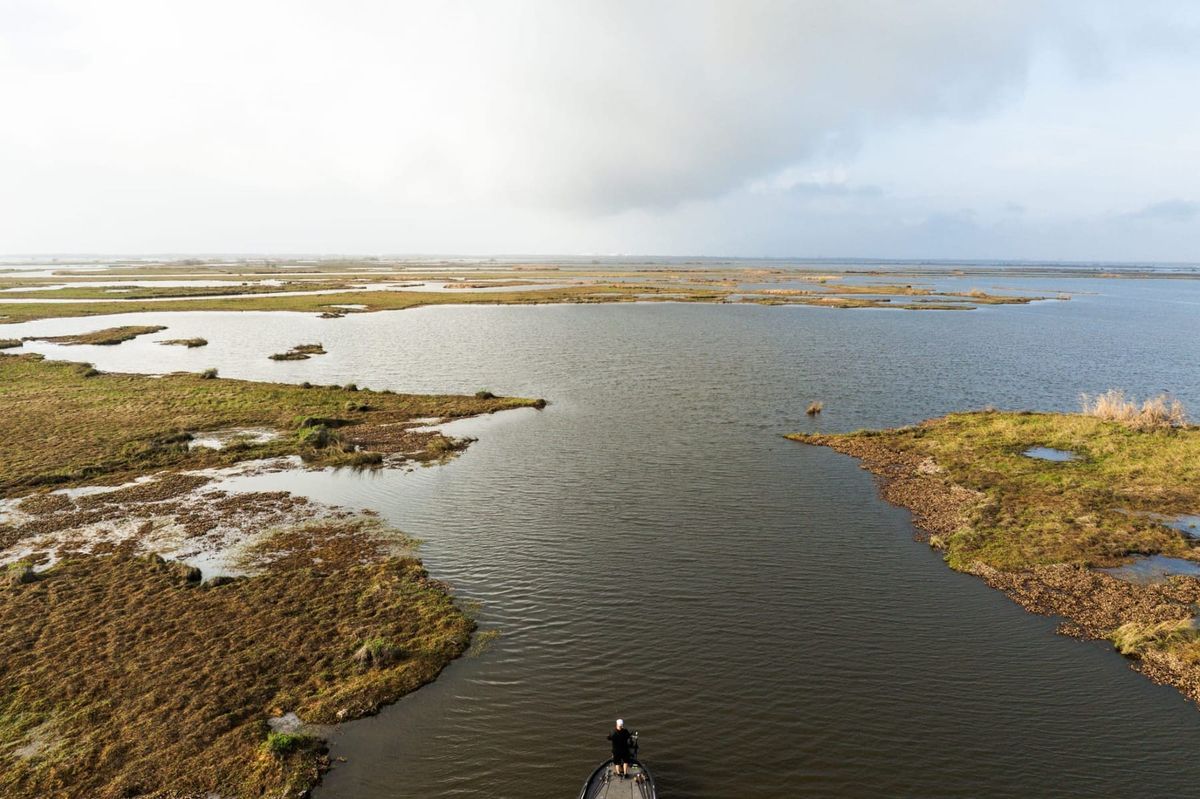
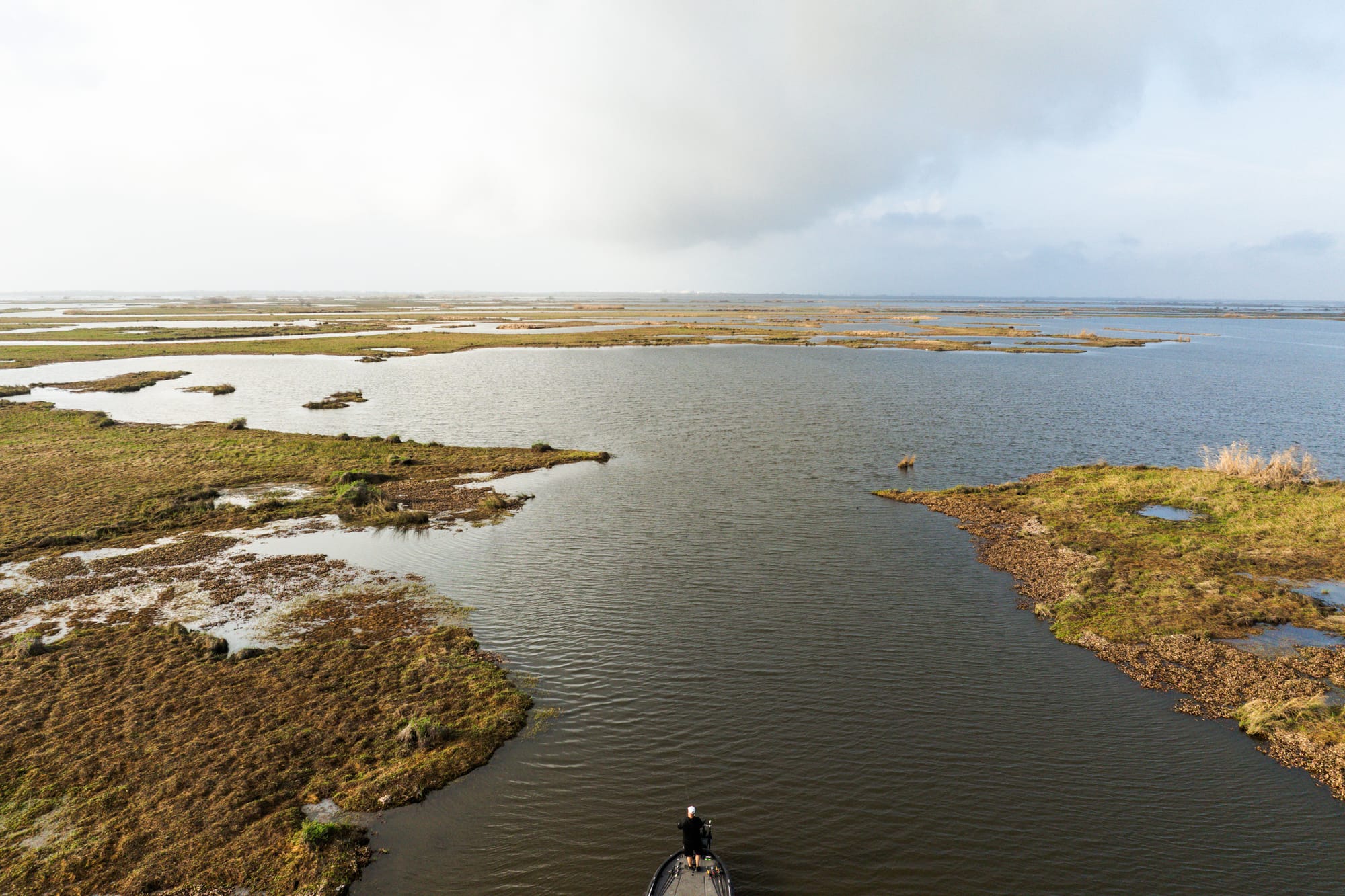
The small store and dusty parking lot, filled with pickup trucks and boat trailers, faded in the distance as Wagley motored out—first past bald cypress trees, their knobby knees showing at the water’s edge, and then into the wider channel of the Intracoastal Waterway. Wagley hung a left into an open bay—a “lake,” in local parlance—where the water transitioned from muddy to clear green, marked by tangles of hyacinth and hydrilla. Any bass fisherman would know this was a prime location.
Before he and his friend could throw a line in the water, Wagley heard a motor in the distance. An airboat shot out from behind the trees.
Wagley recognized Dwayne Crawford at the helm. Like his father before him, Crawford was the land manager for Continental Land and Fur, a company that owns 127,000 acres of contiguous marshlands here in lower Terrebonne Parish. According to Wagley, Crawford had a reputation as a loose cannon and a bully. This was not their first confrontation: Crawford, always armed, had run Wagley off on many occasions, claiming he was on private property. For his part, Crawford maintains that any reputation he has with fishermen is defensive, because “they know they are doing wrong, and they are on private property.”
According to Louisiana law, navigable waters and the water bottoms beneath them are public, owned by the state for the benefit and use of the public. Wagley knew the law and he checked both boxes. He was clearly in navigable, tidal water—he was in a boat, after all, in a spot he knew was always deep no matter the time of year. But Continental Land and Fur had a different interpretation of the law.
The combination of disappearing lands and valuable mineral rights has launched a range war in a state that is known, officially, as “Sportsman’s Paradise.”
Wagley was in no mood for a shouting match, so he made a U-turn to avoid another confrontation. But Wagley says that Crawford, who had a companion in the boat, followed. So Wagley punched the throttle until he was going as fast as he could while maneuvering around the bay’s vegetation. He was at a disadvantage. Crawford’s flat-bottomed airboat could fly right over the plants without getting tangled. According to Wagley, Crawford tried to head off the fishermen by running the airboat directly in front of them. Wagley cranked his boat left, barely avoiding collision. Crawford circled, cut them off again, then turned the fan of the airboat into the side of Wagley boat and gunned it. A torrent of water and wind blew back across Wagley, forcing him to duck.
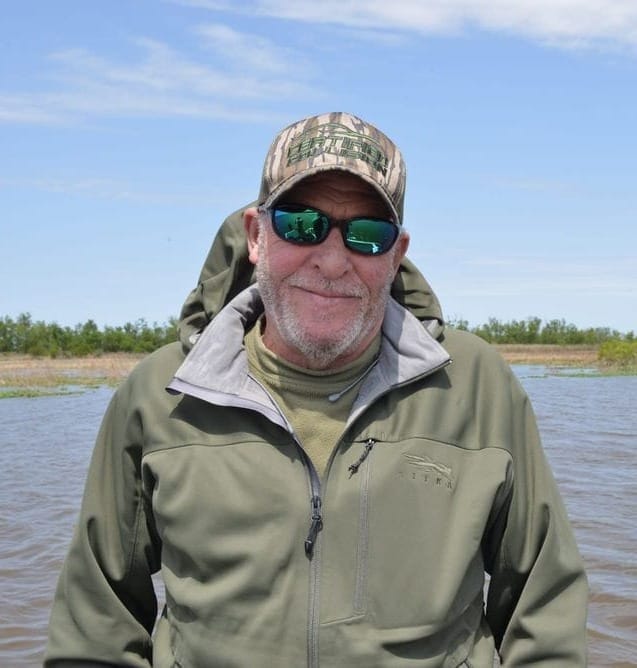
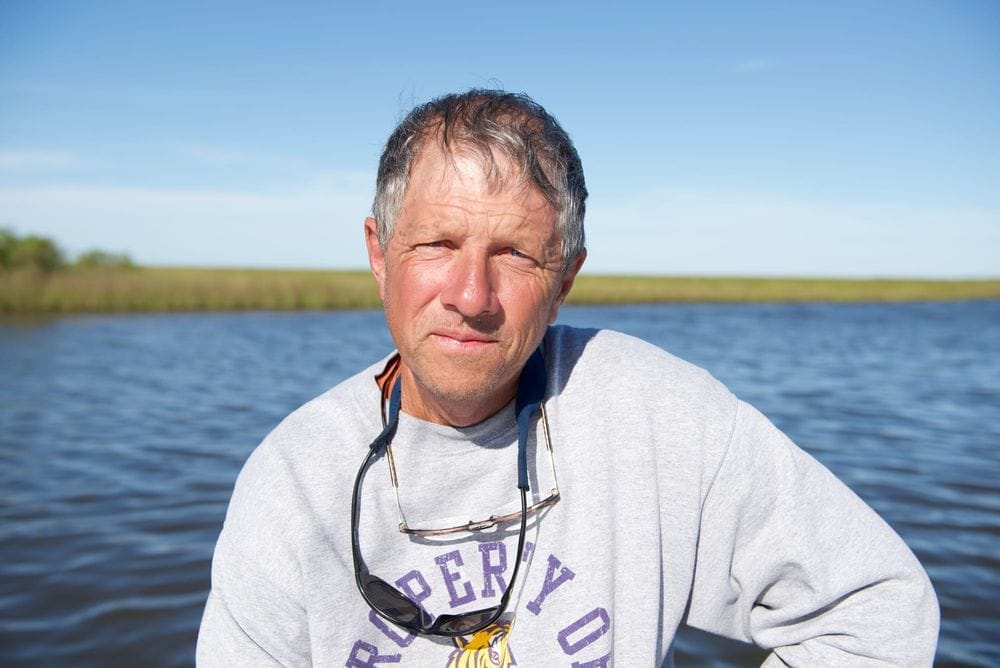
Left: Rodney Wagley was arrested and charged with criminal trespass while fishing. Right: Retired fishing guide Daryl Carpenter hoped to forge a legislative solution. Photos by Carlyle Calhoun.
“It was a bad scene,” Wagley reflected later, “something like you'd see in a movie.”
Crawford refutes this version of the interaction, saying he did chase Wagley, repeatedly gesturing for him to stop, but did not cut him off. Regardless, Wagley escaped through a narrow cut in the trees and eventually made it back to the dock, loaded up the boat on the trailer and headed home.
Two days later, the Terrebonne Parish Sheriff's Department called. In the middle of the chase, Crawford and his companion took pictures of Wagley’s boat numbers and later passed them along to the authorities. The Sheriff’s Department told Wagley a deputy wanted to meet with him at a neutral location. They decided on a local gas station known for its burgers and po’ boy sandwiches. When the deputy arrived, he informed Wagley he was being charged with criminal trespass.
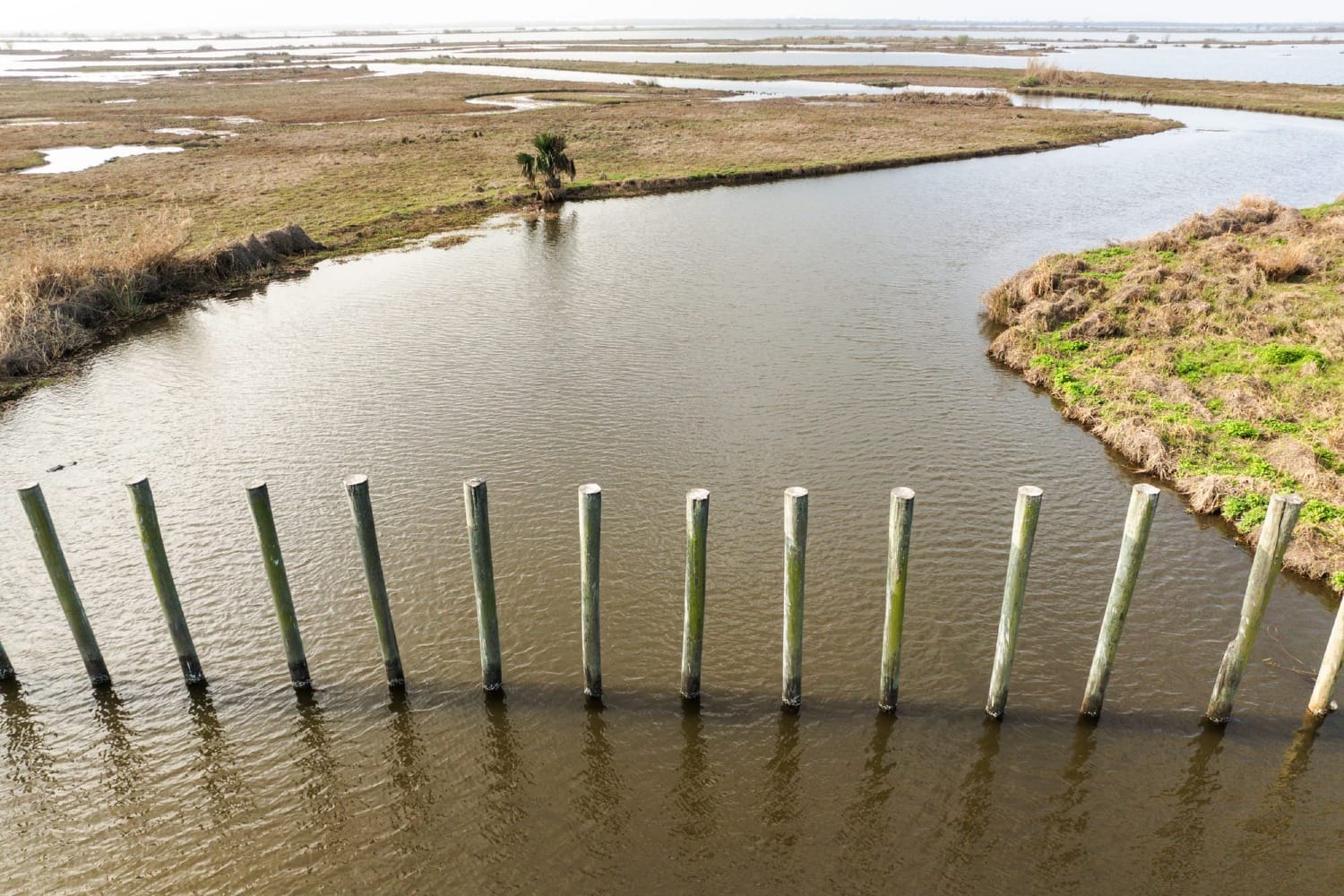
Fifteen centuries ago, when Emperor Justinian decided to compile a tangle of Roman laws into a single, authoritative source, he codified the principle that certain natural resources are common to all mankind and cannot be fenced off for only the few. This principle percolated through history, was strengthened in the Magna Carta, and was adopted in this country's earliest days into a set of common law known as the Public Trust Doctrine. It’s what allows us to freely enjoy a day at the beach, or a tubing trip down a river; without it, the wealthiest among us could own and control every glittering river and seashore.
Still, even though many fishermen live by the mantra that if you can float it, you can boat it, access rights on the water are complicated, as Wagley found. The situation is particularly murky in Louisiana, where private land is disappearing beneath the sea at one of the fastest rates on earth, which means landowners’ rights to the valuable minerals beneath are disappearing, too. This combination has launched a range war in a state that is known, officially, as "Sportsman’s Paradise.”
Wagley is a quintessential sportsman: He plays fair and expects others to do the same. He reveres time spent outdoors. As a kid, he and his friends skipped school to fish in the Atchafalaya Basin—a wild million acres of swamps and bayous and backwater lakes in central Louisiana. Wagley’s backyard was, in essence, an area larger than the Everglades. Just out of high school, Wagley was fishing in local tournaments; he eventually qualified for a sponsored team that competed on the national circuit. In 2001, a few years after a bad injury, he retired from the professional scene, but he never stopped fishing entirely. Why would he? The Atchafalaya is a paradise for adventure. Not only is it a premier bass fishing destination, but you can take off in any direction and find deer or ducks or crabs. “It's just the way we were raised,” he told me. “You're enjoying what I believe our God intended us to do.”
Two centuries ago, though, most people saw the wetlands differently: Louisiana’s watery lowlands did not seem intended for much at all. You couldn’t grow anything in them. You couldn’t build anything on them. So, for decades after the Louisiana Purchase, they sat there, part of the federal estate that no private owner had seen any reason to purchase. In the eyes of the government, they were useless.
By the 1840s, state governments decided they needed to protect communities from floods. And that required money. A solution arrived with a series of “Swamp Acts,” beginning in 1849, which allowed the federal government to transfer around 9 million unsold acres of swamplands to the state of Louisiana, which in turn sold the land to private interests like levee boards—who would ultimately sell the land themselves to pay for flood control. The land went for as little as 12.5 cents an acre. Much was sold to timber companies interested in logging the cypress forests. Other companies, like Continental Land and Fur, leased their land to trappers seeking muskrat pelts, which were sold for fur coats and stoles worn by women from New York to Vienna. One commonly cited estimate puts 80 percent of Louisiana's coastal wetlands in private hands—but, underscoring the problem facing fishermen, nobody actually knows the precise figure.
One key step along the way came in 1901, when prospectors hit black gold in the state. Through the early decades of the twentieth century, oil and gas companies expanded into the wetlands, buying up huge swaths of the region, which held a motherlode of reserves. Some existing land owners, like Continental Land and Fur, held onto their property but changed their business model, leasing not just to trappers now, but oil and gas firms, too.
“There’s no question what the trend is: more and more of the coast is turning into water. More and more of the coast is going to be public,” says Mark Davis, the director of the Tulane Institute on Water Resources Law and Policy. “The real question is, are we ready for that shift?”
Wetlands are a trickier place to drill than, say, the flat, dry land of West Texas. But the money in play provided plenty of inspiration. A mad scramble commenced. The wetlands of South Louisiana, once a remote, swampy waterscape, became an epicenter of oil production. Engineers mounted oil equipment on barges and dug straight canals through the marshes to access their wells—which appear here at some of the greatest counts in the country. By 1990, more than ten thousand miles of canals sliced through Louisiana’s wetlands. This once “worthless” marsh had become quite valuable.
Southern Louisiana is a delta, land built by the Mississippi River meeting the Gulf of Mexico. In natural conditions, it’s one of the most dynamic landscapes on Earth. But the levees built along the river stopped silt from expanding into the delta and creating new land. Climate change, which is raising sea level, makes the problem worse. Over the past century, Louisiana has lost over two thousand square miles—an area bigger than Delaware, mostly privately owned land, gone. And that further complicates the already complex issue of access.
While every state legally recognizes the Public Trust Doctrine, each can interpret it differently. Many coastal states have enshrined the public’s ownership of beaches below the high-tide line. But don’t try laying out your towel on a beach in Maine or Massachusetts; there, public access is limited to below the low-tide line—a soggy place for a towel. And while Texas’s constitution protects access to even parts of privately owned beaches that have historically been used by beachgoers, the Texas Supreme Court is currently considering whether the state is undermining this rule by authorizing temporary closures for spaceflight launches. (A victory would pose a major setback to SpaceX, whose primary launch facility is on Boca Chica Beach in South Texas.)
Rivers are another hotbed of confusion. The Public Trust Doctrine ensures the public’s rights to “navigable waters,” but what exactly does it mean to be navigable? Typically, that means the water has to be able to support commerce, though sometimes just being able to float logs downstream is deemed enough. Even when navigability is clear, you have to be able to get to the water—which is hard to do if the riverbanks are privately owned. When landowners own both sides of a river, they can get rather proprietary: fishing guides in North Carolina complain about the police being called when they’re legally floating navigable water. In 2020, one Georgia landowner shot at a family canoeing down what he claimed was his private water. (He was convicted of aggravated assault and reckless conduct, and the state passed a law in 2024 that codified the right to hunt, fish, and travel in all navigable streams.)
Then there’s the complexity of water bottoms. You may be able to raft down a river in Colorado—there, the public owns the navigable water—but don’t get out of your boat to wade. The water bottom may well be privately owned and you could return home with a criminal trespassing charge.
The question in Louisiana is what happens when what was previously land becomes navigable water. It’s a particular problem in Terrebonne Parish, where Wagley was arrested. The parish is losing land faster than almost anywhere in the world. But this is not an issue in Louisiana alone. Climate Central projects that by 2050, as much as 4.4 million acres of private property could be underwater in the U.S. (The vast majority of the losses will be concentrated in the South, with nearly 90 percent in Louisiana, Florida, Texas, and North Carolina.) “There's no question what the trend is: more and more of the coast is turning into water. More and more of the coast is going to be public,” says Mark Davis, the director of the Tulane Institute on Water Resources Law and Policy. “The real question is, are we ready for that shift?” What will become of local tax bases when the expensive oceanfront properties go literally underwater? Who will be responsible for cleaning up the mess left behind?
Ironically, the oil and gas companies fighting to save their claims in Louisiana’s wetlands helped cause the land’s demise. Those thousands of miles of canals that oil and gas companies cut through the marsh allow salt to penetrate inland, poisoning freshwater marshes. The vegetation helped hold the land together; as it died, the land began eroding. Scientists attribute around 40 percent of coastal land loss to oil and gas canals—including in an industry-funded study conducted by the U.S. Geological Survey.
There’s every reason for oil and gas companies to attempt to maintain ownership of their drowned land: the money at stake. State law makes clear that when land is submerged under navigable water, it becomes public property and asserts that when property transfers hands, the mineral rights go with it. (An exception is made when there is an active lease, a live contract for exploration or extraction). And Louisiana’s mineral rights have at times been worth billions in Louisiana. Charlie Marshall, a longtime lawyer for Continental Land and Fur, notes that owners have been paying taxes on the water bottoms for decades; he believes one day interest in onshore drilling, which has mostly waned, might return.
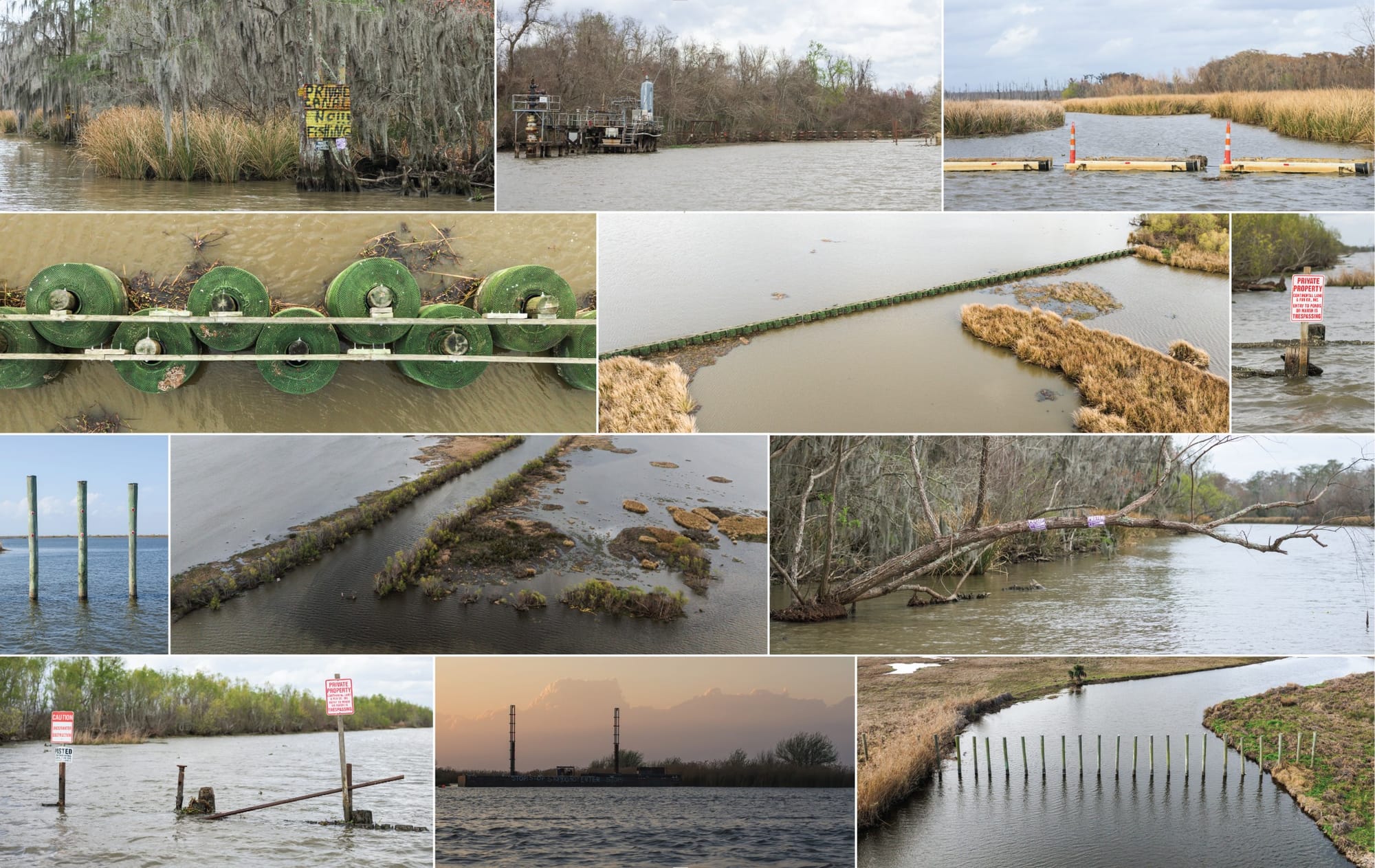
There’s no denying the state is losing land. What landowners dispute is that when private land turns into water, that results in an immediate transfer of title. And official state policy agrees with them: the State Lands Office says that for ownership to change hands, a court must rule on each individual case. Taylor Darden, general counsel for the Louisiana Landowner’s Association, admits that this creates an exhausting legal nightmare. In this collapsing landscape, it’s hard to keep up with who owns what. While the state is required to complete an annual inventory of its owned lands, nothing specifies that it must assess which waters are navigable and therefore state-owned. The last serious effort to do so concluded in 2017, which led to a confusing stalemate: nearly three hundred thousand acres are now considered “dual claimed” by both the state and private owners. For landowners, this reluctance to measure and claim new water bottoms is convenient, as they retain their assets—and their right to keep fishermen out. Fishermen, however, say this reluctance hangs them out to dry. And while some parishes don’t arrest fishermen, some act aggressively on behalf of their landowners.
Daryl Carpenter is a quick-witted, blue-eyed fisherman with a background in law enforcement who until he retired this year ran a guiding service out of Grand Isle, Louisiana. In 2016, after a landowner complaint, he received a warning from the police that he'd be arrested if he was found on disputed water. Carpenter filed his own lawsuit and settled out of court with an oil company—receiving just enough, he says, for his pro bono lawyer to recoup costs. But the experience made him rethink a place sometimes called “America’s Wetlands.” Only around 20 percent belongs to the public. “The rest of it, quote unquote, belongs to somebody else,” he says. “If you don't have his permission to be there, you may have some drunk pulling a gun on you or a Sheriff's deputy kicking your door in. So is it America's wetlands?”
Carpenter worries someone might eventually get killed in a fight over access. The issue has become a threat to Carpenter’s industry, too, recreational fishing: Louisiana was once a favored destination for the Bassmaster Classic—the most prestigious tournament of its kind (and a tournament that Rodney Wagley was once a local favorite to win, until on the first day of competition he hit an object and his boat spun out of control, causing him to break his hand in multiple places). Fishing tournaments are a boon to local economies, with some bringing in over a hundred thousand spectators, as many as travel to a city for a Super Bowl. But in early 2018, the tournament’s sponsor, the Bass Anglers Sportsman Society, pulled its professional tournaments out of the state, excepting just one inland reservoir where access has been clearly defined. Why bring competitors to a state where they might be arrested, or harassed by gun-wielding guards? Louisiana no longer requires private landowners to post their property as private. Even state maps come with a disclaimer that the maps should only be used as initial research and do not provide evidence of what officially is public or private. So how would one even know if they were on claimed property?
Carpenter had spent years searching for a solution that could finally turn the tide for fishermen. He’d been begging landowners—mostly oil and gas companies—to come to the table, find a compromise that could work for both sides. But “none of them will do it,” he told me in 2018, in Baton Rouge. We were standing in the state capitol building in Baton Rouge, waiting for a vote. “So here we are. We're working toward a showdown.”
Legislators would soon debate House Bill 391—which, per the official summary, would address “public access to the running waters of the state,” finally aligning Louisiana with the rest of the nation, where tidal waters are open to the public. For the most part, the fishermen are politically conservative. They support the rights of oil and gas. (Carpenter describes himself as “drill, baby, drill.”) The bill he’d helped develop was only about access—it would not challenge the companies’ mineral rights. He’d felt confident about its prospects until he got intel about the oil and gas companies bringing in a battery of lobbyists.
The experience made Daryl Carpenter rethink a place sometimes called “America’s Wetlands.” Only around 20 percent belongs to the public. “The rest of it, quote unquote, belongs to somebody else,” he says.
Carpenter had troops, too—a single paid lobbyist of his own, plus hundreds of fishermen. In their candy-colored technical fishing shirts, they were easy to distinguish from the lobbyists darting around the building in a flurry of dark suits and shiny shoes. A state representative named Jerry Gisclair ambled through the crowd to introduce himself to a group of fishermen I was standing with. (In a perfectly Louisiana moment, he told us to call him “Truck.”) Gisclair represented part of LaFourche Parish, where Carpenter ran his charter business. It’s a hotbed for posted waterways and confrontations.
“This is starting to no longer be ‘Sportsman’s Paradise,” Gisclair told us. “It’s richman’s paradise. And I’m trying to get it to a place where Joe Weekender can go fishing.” He noted, though, that he’d “been hearing from all sides. It’s a very touchy and sensitive issue right now and it’s affecting a lot of people. So we're working on it and it's gonna be a pretty contested issue today.”
Carpenter knew that the bill’s sponsor was being pressured to pull it. He figured few lawmakers wanted to cast a vote. “It’s a lose-lose for them,” he said. If you come to New Orleans’ famous Jazz Fest, you’ll be greeted by a huge Shell welcome banner. In Baton Rouge, an ExxonMobil refinery stands like a backdrop to the capital. Generations of Louisianans have worked in the industry. At one point in the 1980s, revenue from oil and gas accounted for nearly half the state budget. Companies like these are powerful players and, according to Carpenter, are “vindictive as hell.” He’d heard rumors that they’d already threatened the politicians with withdrawing future campaign contributions. But the legislators also knew that the fishermen were the ones who pulled the levers in the voting booth.
Carpenter sat with a few other fishermen in the balcony to watch the proceedings; he kept tapping his leg with an empty Diet Coke bottle. “Everything relies on this vote,” he said.

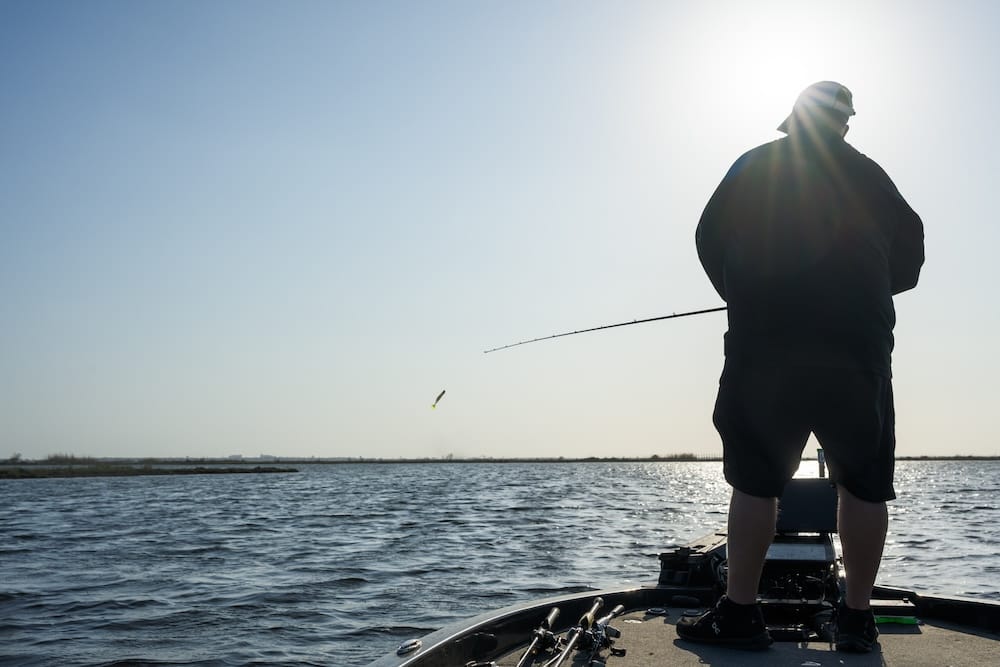
Lucas Ragusa, who heads the Louisiana Sportsmen’s Coalition, fishes inthe open waters along River Aux Chenes near Delacroix — not far from the canals where Rodney Wagley was confronted and later charged with criminal trespass.
If House Bill 391 had passed, Rodney Wagley never would have been arrested. But the bill lost by a landslide. Even Gisclair—Truck—the representative who said he was fighting for Joe Weekender, voted against it. (Gisclair left the statehouse in 2020, and said that he was unaware of any campaign contributions being withdrawn. He voted no, he said, because he believed that liability questions hadn’t been solved. Former oil land was full of submerged hazards, and he wanted to wait for a study then underway. In the eight years since, though, no new bill on the issue has made it out of committee.)
Wagley said that having the criminal accusation hang over him was a “nightmare.” But the issue was important to him. “I’ve spent my whole life in these waters. This has been my life,” he says. So he knew he’d fight the charge, even if it took digging into his savings for a legal bill that could reach well into five figures.
A few days after his arrest, an acquaintance introduced Wagley to a lawyer named Eddie Lambert. A lover of crawfishing, crabbing, and catfishing himself—and a state senator who was well aware of just how contentious the issue had become—Lambert offered to represent Wagley pro bono. He thought Wagley’s case had a chance of reaching the Louisiana Supreme Court, where a precedent protecting the public’s access to navigable, tidal water could finally be established. Wagley was nervous; he’d never had to work with a lawyer before, let alone to take on powerful corporations. But Lambert convinced him that, together, they could do it—that this was a fight bigger than either of them, it was for every Louisianan.
The trial was held in 2022 at the Terrebonne Parish Courthouse, an imposing, columned hulk of a building. Though the state prosecuted the case, Marshall, Continental Land and Fur’s lawyer, attended to keep an eye on the result. Amid the subdued meet-and-greet before the proceedings, a lawyer approached Wagley and asked if he had any idea what fighting the company was going to cost him personally. But Lambert overheard; he stepped up beside Wagley and told the lawyer that “it's not gonna cost Mr. Wagley nothing.” (Marshall, who believes he was the company’s only lawyer present, has no recollection of this conversation.)
Wagley assumed that he would not get a fair trial. Terrebonne Parish, which pulls in hundreds of millions annually from the industry, has a reputation as a place forever friendly to the oil and gas companies. Wagley knew that both the local district attorney and the judge were born and raised in the parish; he figured they were sympathetic to Big Oil. (Neither responded to requests for comment.) “Now I don't have no facts, but look, my dad used to say he was born at night, but it wasn't last night,” Wagley told me later. “And so I knew we were going up against a lot.”
The trial lasted nearly seven hours—extraordinarily long for a misdemeanor case. Lambert’s expert witness offered testimony that the water variation in the lake where Wagley was fishing was anywhere from two to six feet. That it was subject to an astronomical tide of five inches. That it was navigable, tidal water, then—proof that Wagley was not trespassing.
The judge found Wagley guilty. He fined him one hundred dollars, the minimum sentence.
Lambert petitioned an appeal court—which, without further oral argument, threw out the Terrebonne judge’s decision, noting that the state’s attorney had failed to prove his case beyond a reasonable doubt.
Lambert convinced him that, together, they could do it — that this was a fight bigger than either of them, it was for every Louisianan.
But the case still wasn’t over. The district attorney asked the Louisiana Supreme Court to take a look at this decision—just as Lambert had hoped might happen. This would be the first time in nearly a century that the court could directly rule on public access to navigable, tidal water. Lambert thought they could set precedent that could stop the wide-scale privatization of one of the most unique estuaries on the planet. Continental was also enthusiastic about an appeal, though they hoped to set a different kind of precedent. So did the Louisiana Landowner’s Association, which submitted a brief to the Supreme Court that indicated leaving Wagley’s conviction overturned “could create a dangerous precedent that threatens every property owner's constitutionally protected right to forbid entry to anyone, for any reason.”
After several months, “the Supreme Court said ‘We're not touching it,” as Lambert put it to me. (Court documents show that two of the judges wanted to hear the case, given its high level of interest to the state, but they were overruled.) This meant the Court of Appeals decision stood. There was no trespass conviction. It was all over.
Except that it’s not. Wagley worries that by challenging an oil and gas company, he’s poked the tiger. Motoring through the bayous of Terrebonne Parish, Wagley sees more and more blocked waterways— “we're talking hundreds of thousands of acres that are literally being closed to us” across southern Louisiana, he says. Lambert’s feelings are mixed, too. He sees the supreme court’s refusal to rule on the case a reflection of the same lose-lose calculus that stopped the legislature from taking up the issue. The trespass issue is a hot potato no one wants to touch, he told me.
As Louisiana disappears, a vast amount of water should become public property, open to fishermen—but, officially, it’s not. As I studied the issue, I could not help but notice how the status quo benefits many entities. Landowners get to keep their land and mineral rights; the local parishes get more tax dollars. Why would a set of Supreme Court judges—or a set of legislators—want to rattle this cage? But, unfortunately, the status quo does not serve the public. To gain access to waters that should be public, a fisherman has to fight, in court, for every bit of new territory.
Dwayne Crawford, Continental’s land manager, told me that he does not approach fishermen who are traveling in wide-open canals that cut through the company’s property. He only confronts people who have left major canals and entered the interior marsh, where people hold hunting leases, and where there are clearly posted signs demarcating the private property. Continental Land and Fur still believes that Wagley should—and would—be arrested if he shows up on those waters.
Still, Lambert advises Wagley to go out there anyway, and not to flee if he’s approached. Try to have a civil conversation, the lawyer tells the fisherman. “ We've got to make a stand,” Wagley told me. “If they give you a ticket, take it to court and fight it. And if everybody was to do that, we would win.” The trouble, he knows, is that few people have the time or the money. “They just don't,” he said.
This story originally appeared in Issue No. 02 of Southlands.