

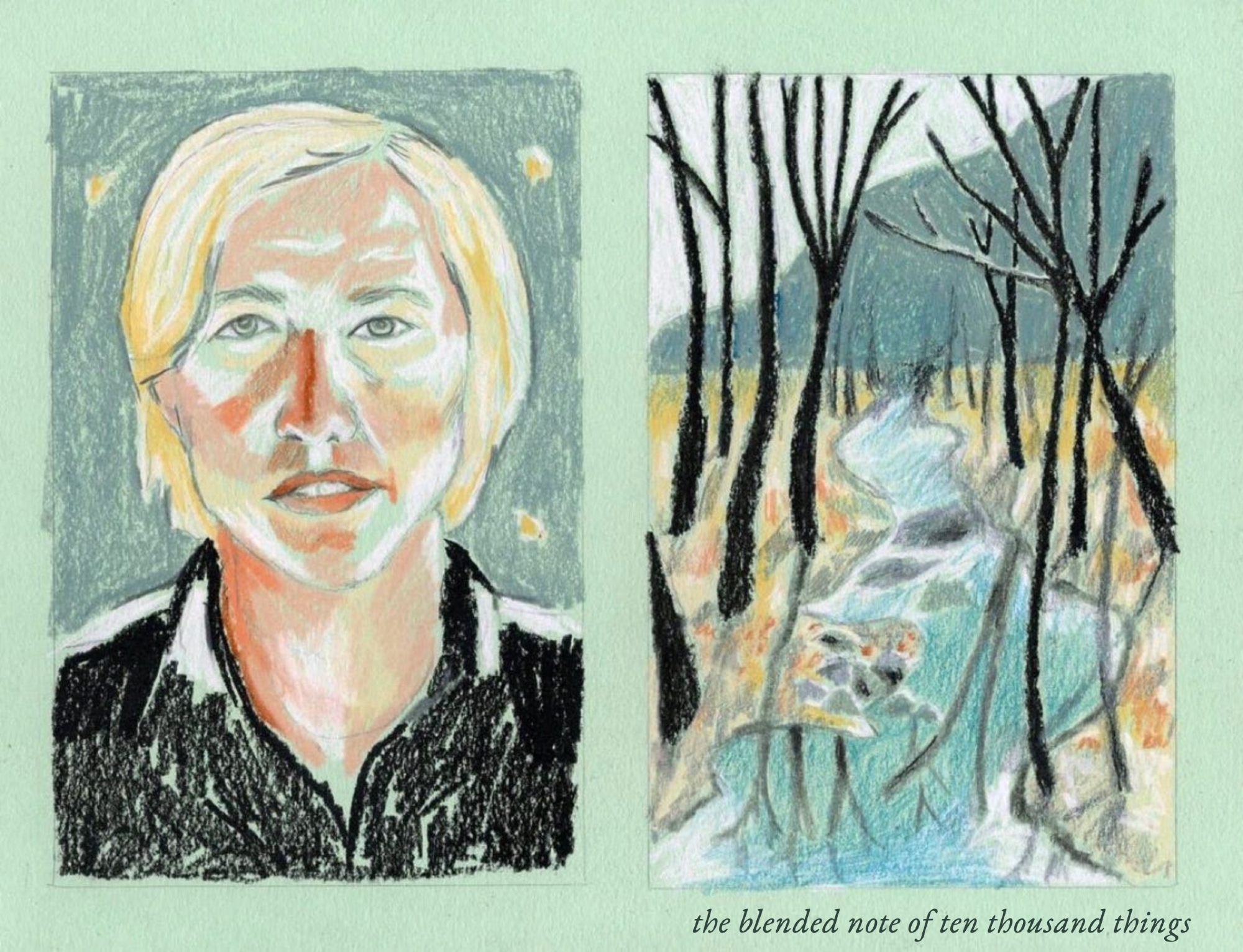
This essay was first published on the Substack of Southlands' friend — and, we hope, future contributor — Martha Park. With her permission, we're now republishing it on our website and in our newsletter.
I used to see Annie Dillard everywhere, at every age she’d ever been: once in the blonde braids and wide grin of a girl crossing campus; another time in the husky smoker’s voice of a woman ahead of me in line at the airport. I’ve seen her on the trails winding through the mountains where we both made a home, forty years apart. She’ll be just ahead of me, walking with a dog off-leash, stopping every so often to watch as a bird bursts into flight. Or she’s resting a while on a boulder, taking a drink from a thermos or adjusting her backpack.
She could appear anywhere, at any time; like Christ’s holy face emblazoned on a piece of burnt toast, Annie was imminent, showing up where she should not be, disappearing from view as quickly as she appeared.
When I was twenty-five, I moved to Roanoke, Virginia because Dillard had lived there. When I applied to the graduate program at Hollins University, I wanted to write, but mostly I wanted to follow her literal footsteps across campus and along the banks of Tinker Creek. I followed her to Roanoke because I thought she could teach me something about devotion—if not to God, then to the world itself.
As the school year approached, I wasn’t sure what to expect of Dillard’s presence—would her shadow hover over campus, darkening our paths to and from workshops, reminding us of all the ways our own work stopped short? Would we talk about her all the time? Or at all?
But once classes started, I discovered that Dillard’s work was not a settled subject. Some of my classmates were troubled when they discovered central scenes in Pilgrim at Tinker Creek were imagined, or taken from reading, and not from life: she never saw a frog deflate in person, only read about that in a book. There was no tomcat with bloody paws; she’d pilfered the detail that opens the whole book from a friend, one of her classmates at Hollins. And we all knew she was no solitary pilgrim, but lived with her husband, the writer Richard Dillard, who was now our own avuncular fiction professor.
At the Hollins library, I checked out Dillard’s 1968 graduate thesis, in which she explored the way Henry David Thoreau constructed Walden Pond as the central image of his book. Dillard links Thoreau’s descriptions of the pond’s surface and the sky it reflects with “the mystic’s vision,” moving from earth to heaven and back again: “Up and down maintain a constant dialectical tension, informing Thoreau’s vision with a rich, two-toned harmony. Thoreau’s own consciousness is the synthesizer, the conductor.”
As a fact of nature, Dillard writes, the pond’s meaning derives “from its physical, factual attributes…because the pond remains the same, its meaning is always the same and will always be the same for any right-thinking man who devotes his attention to it.”
Annie was imminent, showing up where she should not be, disappearing from view as quickly as she appeared.
Reading her thesis, you can get a sense of the vision for Pilgrim at Tinker Creek taking shape in the background. In contrast to Thoreau’s pond, Dillard’s Tinker Creek is a central image built on constant change, always on the cusp of transforming itself. It doesn’t give itself over to easy observation: the frog on its surface is not a frog for long before it deflates; the coots and muskrats on the creek’s edges can only be observed through Dillard’s synthesizing consciousness stalking and hiding, watching for secretive glimpses, a flash of fur or feathers.
In the opening pages of Pilgrim at Tinker Creek, Dillard compares her house to the small structures, often attached to churches, in which medieval anchorites lived in solitude: “I think of this house clamped to the side of Tinker Creek as an anchor-hold. It holds me at anchor to the current, as a sea anchor does, facing the stream of light pouring down. It’s a good place to live; there’s a lot to think about.” The conceit of Pilgrim is that the pages that follow are the fruit of her devotion, of her solitary life anchored to a place and all that she can observe there.
Dillard is our lone guide through the blustering world, and we learn each inch of Tinker Creek through her strange, overactive mind: black beef steers are “a human product like rayon”; clouds move across the sky “like a tablecloth whipped off a table.” “We don’t know what’s going on here,” Dillard writes, while venturing a guess: “The answer must be, I think, that beauty and grace are performed whether or not we will or sense them. The least we can try to do is be there.”
A few years ago, people online started to turn against Annie Dillard. One anonymously published essay titled, Put a Bird on it: The Many Disappointments of Annie Dillard, begins, “I want to tell you the truth about Annie Dillard: she sucks and apparently no one else wants to say it.” The writer complains of Dillard’s frequent descriptions of birds, which he (I’m assuming) dismisses as lazy, “a failure of vision…as Portlandia reminds us, put a bird on it and it will sell.”
In a March 2016 article in The Atlantic, William Deresiewicz speculates that Dillard’s work has slowed to a trickle as she aged because the kind of spiritual experiences Dillard describes in her earlier work are the territory of the young. To Deresiewicz, Dillard is not only a hypocrite and a snob, but someone who passes off her knowledge of one thing—“that we are born with souls but die in bodies”—as knowledge of many things.
“Some things that are old become venerable, others become cliched, others just cease to speak to the times,” Kathryn Schulz writes In The New Yorker. “It is growing ever more difficult to sustain the spiritual-pilgrim mode of nature writing, the mode of William Bartram and Ralph Waldo Emerson, of Annie Dillard and Peter Matthiesen. Such pilgrims venture forth in search of enlightenment or replenishment, but only the least interested or trustworthy narrator can have failed to notice by now that nature’s existential condition needs at least as much tending as our own.”
But I never got the sense that Dillard was a “spiritual pilgrim,” and I wouldn’t have called her writing “nature writing.” I thought she was up to something else: using the world as a way to glimpse the sacred, to write into encounter with the divine — not in a way that enlightens, but in a way that burns.
I have my own beloved Annie Dillard texts: For the Time Being, The Maytrees, Teaching a Stone to Talk. Pilgrim would not be at the top of my list. But it nags at me. The book as it is commonly described feels so different from the way it felt to me as a devoted reader experiencing it for the first, second, fifth time.
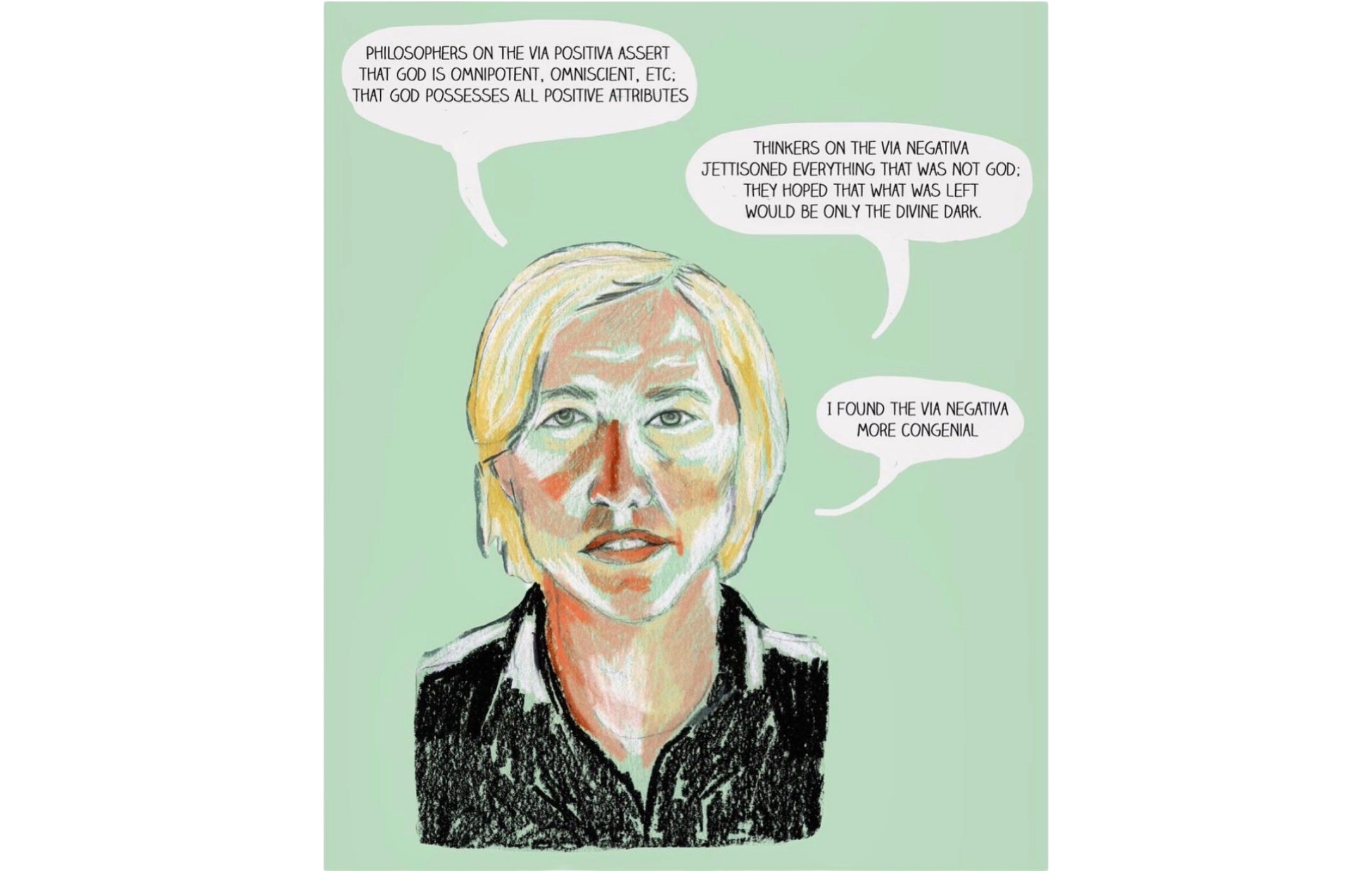
In a 1999 afterword to Pilgrim, Dillard explained the two-part structure of the book: the first half dramatizes the via positiva, or the idea that God is within the world, and that God can therefore be understood through observing the world. The second half dramatizes the via negativa, the idea that God is apart from the world and fundamentally unknowable, understood not through the accumulation of understanding, but through chipping away at what is not God.
The book’s first half contains its most beloved scenes—seeing the tree with the lights in it, or patting the puppy—all shorthand for being present, awake. The writing in this first half is awed and breathless with wonder, and the surroundings are contained and definable: the creeks, she writes, “are an active mystery, fresh every minute.” The mountains, by contrast, “are a passive mystery, the oldest of all…The creeks are the world with all its stimulus and beauty; I live there. But the mountains are home.”
The book’s middle chapter, “Flood,” works as a hinge between its first and second half. When the waters of the creek swell, everything we’ve known is washed away, and the world left in the flood’s wake — all sludge, drowned insects, bloated dead frogs — is new and strange.
The second half of the book, like the first, opens with Dillard waking from sleep. But in the second half, she is screaming herself awake from a dream of mating Luna moths. “I don’t know what it is about fecundity that so appalls,” she writes, “I suppose it is the teeming evidence that birth and growth, which we value, are ubiquitous and blind, that life itself is so astonishingly cheap, that nature is as careless as it is bountiful, and that with extravagance goes a crushing waste that will one day include our own cheap lives…”
The numbers begin to pile up in Dillard’s head: the millions of birds in the air and lemmings on the ground and grunion in the sea, the crowds of ants and mayflies and cicadas swarming and molting and dying, too thick to count. Dillard tried to conceive of herself as one of the unfathomable hoards: “What if God has the same affectionate disregard for us that we have for barnacles?” she writes, “I have hatched, too, with millions of my kind, into a milky way that spreads from an unknown shore.”
Dillard’s discomfort with the via positiva is clear: if we learn about God through nature, the God we meet might be intolerable. There is something about the via negativa, about God’s essential unknowable-ness, that Dillard says she finds “congenial,” only deepening the mystery of God and nature and releasing her — us — from the burden of knowing anything definitive or sayable at all.
In a 1978 interview with Phillip Yancey in the evangelical magazine Christianity Today, Dillard tries to set the record straight about her first book. She’s thirty-three years old, and Yancey is pushing her to articulate a summary of her religious beliefs. “If I wanted to make a theological statement I would have hired a skywriter,” Dillard says. “Instead, I knock myself out trying to do art, and it’s not so airtight. It isn’t reducible to a sealed system. It doesn’t translate so well.”
Though she writes about God and mystics and nature, Dillard does not mean to say she lives her life in a state of ecstatic solitude, focused prayer, and searing attention: “I do not live well,” she says in the interview, “I merely point to the vision.”
Maybe this is one reason for her readers’ disappointment, for the gap they feel between the Pilgrim’s narrative and the author’s life. Maybe readers inspired by the vision Dillard points to might also like to travel that distance—between the vision and real life—with her. Maybe that’s what feels like a trick—we’re not let in on the days that falter, when the brain goes foggy or when the hours get overwhelmed by errands and obligations. Maybe, more than arriving at the vision, her readers would like to know how one gets a little closer, in those moments—stuttering, fleeting, and occasionally expansive—that make up a life.
In his essay “Annie Dillard and the Writing Life,” Alexander Chee recalls Dillard’s instructions as a writing professor at Wesleyan University: “You can invent the details that don’t matter, she said. At the edges. You cannot invent the details that matter.” I guess the catch is that the details that don’t matter to the writer might be details that matter to the reader. It’s hard to say what will matter, what will stick.
True or false? The answer was always yes; both
Her un-truths never gave me much pause. As a preacher’s kid, I’d grown up with a story that many, many people argue would lose all its meaning if it weren’t literally true—but I never believed it was. I was raised believing that these stories were, at once, true and not-true, but never a lie—believing that these stories only meant more as they unfolded in mystery and resisted being pinned down to any neat, singular meaning. True or false? The answer was always yes; both.
I remember a brief conversation with Richard Dillard, Annie’s first husband and her professor, who has now, also, died, but was then my professor. As we stood in a dark foyer during a reception for some famous writer, (Richard) Dillard told me that some books have a way of writing and unwriting themselves. One example he tossed out was the Bible, the way the world created in the Hebrew Bible was completely transformed by the New Testament.
It seemed clear to me that Pilgrim was a book that also writes and unwrites itself, building up the scaffolding of a worldview before washing it away and wandering the wreckage. In her two-part structure, Dillard dramatizes two ways of believing—in God within the world and God without—so viscerally that we can visit both of those worlds and see what it would require of us to live there.
It doesn’t matter to me whether Dillard saw the deflated frog herself or read it in a book, but perhaps this is because I am the kind of person who would uproot her life because of something I read in a book—that a woman could wander out into the world around her and into her own mind and, with enough time and attention, be able to say something about herself and the world and God. The goals and effects of Dillard’s project seem to move it somewhere beyond categories like nonfiction, or nature writing. It is as experimental and fickle as a parable, gesturing at the world beyond the story in a way that transforms it before our eyes.
A year after leaving Roanoke, on our honeymoon, my extroverted new husband strikes up a conversation with the older couple sitting at the table closest to us in a restaurant. Over time I begin to feel convinced that the woman sitting two feet away from me is, in fact, Annie Dillard.
That after all the near-misses, the visions I’ve had of her over the years, here she is, finally. As her husband tells us about their home in Florida, about their trips to their second home in the mountains, about how she likes to read and hike with her sister, how hard the two of them laugh when they’re together, I tick off each fact that aligns with those I’ve gathered about Dillard’s life and it all checks out—or just close enough that I can’t shake the sensation, that this time it’s really her, sitting an arm’s length away from me, both of us saddled, somehow, to men who could talk to a brick wall. I notice traces of blonde in her shock of short white hair. I notice the slight unevenness of her front teeth, her red cheeks, the faint lines around her mouth from years of cigarettes.
Whenever this happens, some part of me knows it isn’t really her. At the restaurant, I remind myself that Dillard’s husband is a Thoreau biographer, not a math professor, and that she spent time each year in Key West, not St. Petersburg. But it seemed so imminently possible that this is how I would finally meet her, in a small mountain town, sitting over steaming bowls of soup, trapped by small-talk.
I thought about the first days of my first semester at Hollins, when I saw fluorescent flyers advertising an upcoming undergraduate theatrical production of Pilgrim at Tinker Creek. At the MFA program’s meet-and-greet, one professor joked about the play, saying he’d be playing the withered frog, or the sense of sight, or maybe light itself.
It was spring when the student production of Pilgrim at Tinker Creek premiered, and we lined up outside the theatre in the blue-grey shadow of Tinker Mountain. I took a seat as the lights dropped, then gently returned, to show black-clad students silhouetted on the barely-lit stage.
At first, hearing Dillard’s descriptions of time and nature and sight—recited by undergrads I regularly saw in their pajamas in the cafeteria—seemed goofy and embarrassing, like watching a reenactment of someone’s stoned revelations in a musty basement bedroom. I was too aware of us all sitting there in the dark, too conscious of the woman slowly unwrapping a peppermint in the row directly behind me. But scattered amongst the fumbled lines and popping mics and my own wandering, restless brain were moments rising up from nowhere to transform those of us watching, slack-jawed, from the cheap seats.
A girl in the center of the stage placed small oval stones into a pool of water and rubbed them dry, while reciting Dillard’s lines: I want to stick a net into time and say ‘now,’ as men plant flags into the ice and say, ‘here’. Later, a disembodied voice—deep and husky, sounding more like Dillard herself—spoke from backstage, while students stood motionless, arms outstretched, reaching for each other.
They seemed to hold within and between each other a certain surface tension, like beads of water suspended on a wire. And from the effort of it all emerged—as Dillard warned us it might—some unmerited, unnamable grace, performed for us, whether we sensed it or not.
More than a decade later, this morning, I’m in the middle of interviewing a regenerative farmer and Episcopal priest for a story I’m writing, when my phone vibrates and I see the text from my friend, Lena, that Annie has died.
(Two weeks ago, I had messaged Lena about Wendell Berry’s death: When Dolly Parton died, I’d thought “Not Wendell Berry,” and when Wendell Berry died, I’d thought “Not Annie Dillard.” Lena and I had talked about the way Annie’s work shaped us. “Thank you Annie Dillard for our lives,” Lena wrote two weeks ago, and today she is gone.)
As I try to keep asking the person on the other end of the phone questions, I can hear my voice get shaky. I’ve spent the past week re-reading Teaching a Stone to Talk, something I often do when I’ve written my way into a corner.
I’ve been enjoying the familiar magic of revisiting sentences I underlined years ago, finding I’m drawn to different lines now. Now it feels like a strange, timely communiona last chance encounter, passing in the halls.
After my interview ends, I pick up “Teaching a Stone to Talk” again. I used to have the final lines of the book’s title essay committed to memory. I feel my heart start to race as those lines approach: “The silence is all there is. It is the alpha and the omega. It is God’s brooding over the face of the waters; it is the blended note of the ten thousand things, the whine of wings. You take a step in the right direction to pray to this silence, and even to address the prayer to ‘World.’ Distinctions blur. Quit your tents. Pray without ceasing.”