
I first connected with photographer Mac Stone when National Geographic paired us up on a story — or, really, the. magazine asked me to write a brief essay to accompany Mac's epic photos of Florida's mullet run.
Once I googled his name, I realized I already knew his photos, both at Nat Geo (he is a National Geographic Explorer, after all) and at Garden & Gun. Really, if you read magazine stories about nature in the South, it's all but inevitable that you'll wind up coming across his photos. As I got to know him, I found he was not just immensely talented, but kind and friendly, too.
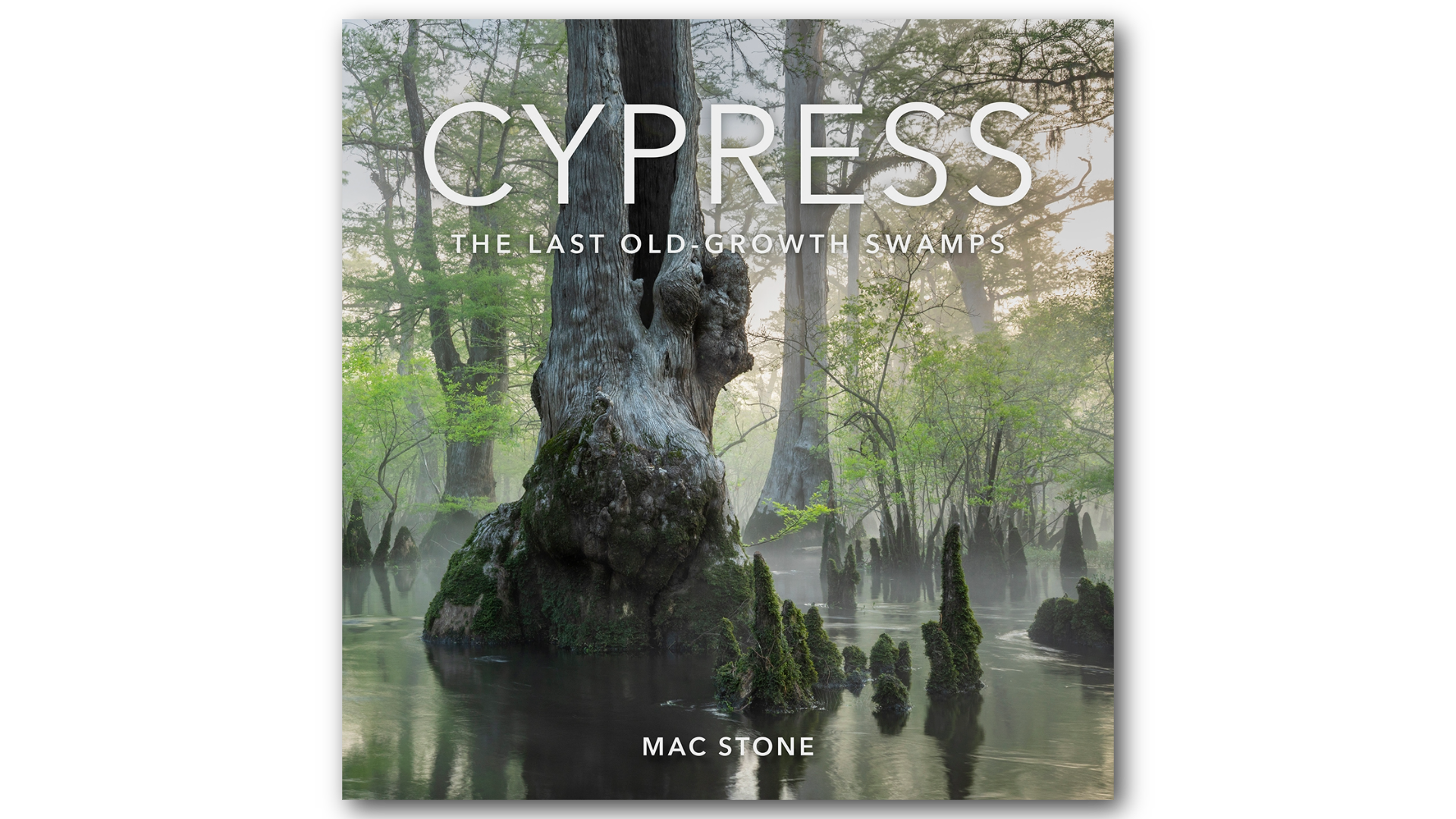
Still, when I asked the University Press of Florida if I could take a look at a copy of his new book Cypress, I was skeptical. I was attracted to the subject matter, of course — the South's last stands of old-growth cypress — but I've never been a huge fan of photobooks. They often feel more like decor than literature: just something to put on your table at your fancy vacation home, if you can afford one.
Cypress could be that, I guess, but it's clearly something more. Mac is too much of a nerd about the details for it not also to be an essential text for understanding an all-but-lost Southern ecosystem — swamps that Mac compares to the Mona Lisa.
I asked Mac to sit for our standard questionnaire but, fitting to who he is, he wanted to hop on the phone instead. So here's a slightly edited version of our conversation, about the wild South and how he captures it in photographs.
—Boyce
Boyce: The first question I ask everyone is "what is your Southlands?" You can interpret that however you want.
Mac: My Southlands has changed a lot recently. I used to be primarily focused on swamps — that was just what interested me the most. Then my coverage started broadening into the longleaf pine forests, and then into the maritime forests and the springs and the prairies and the oak hammocks, and then the Southern Appalachians. It all became connected through water — the way that water and topography change the Southeast.
So for me it’s the whole region now. My Southlands is the South. It’s everything, which can be overwhelming. But you find representative ecosystems, representative species, that can contain the narrative of a given landscape. That has been really fun — trying to find those little interactions that represent the whole.
Your latest book focuses on cypress trees. How did you settle on that?
Cypress was just what was in my backyard growing up in Gainesville. My outings — to find sharks’ teeth, to explore, to figure out what made my hometown tick and what made it different — happened to be among cypress trees. And the more I kept exploring, the more I would find.
These are areas people don’t really go into. So I found a lot of solitude. I found a lot of reflection, and I found a lot of adventure. I’ve been doing this for twenty years, and I still go into these places and I’m amazed by the things that I see.
Cypress swamps are also the underdogs, and the underdogs need cheerleaders. I just happen to be one of their big cheerleaders.
Twenty years is a long time. How did you know when the project was complete, and ready to become a book?
Twenty years is really the early part of my career. This project started in earnest in 2008, though I didn’t know it at the time. That’s when I first visited Beidler Forest [in South Carolina’s Four Holes Swamp]. I lived there as a naturalist for five or six months, from spring into early summer.
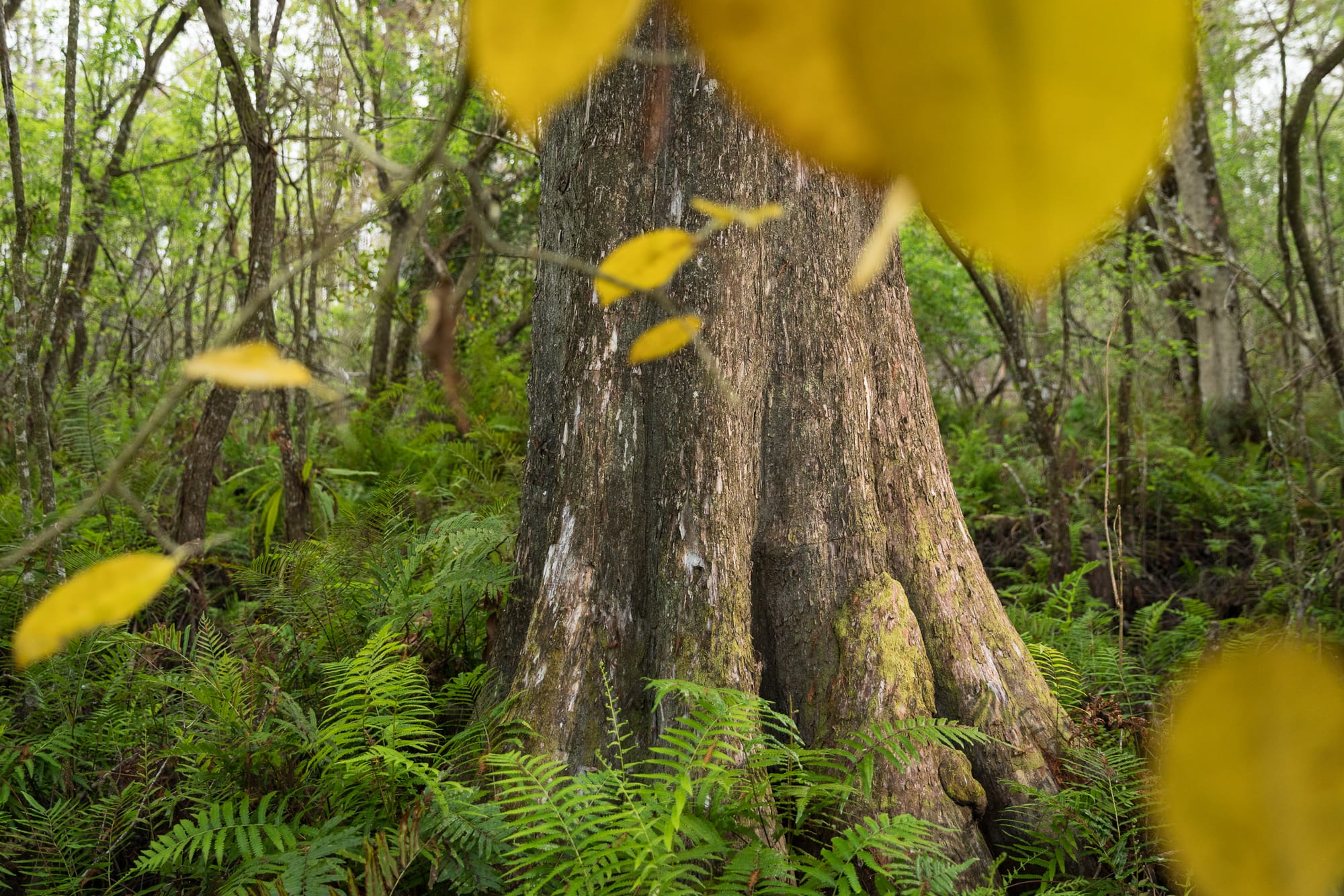
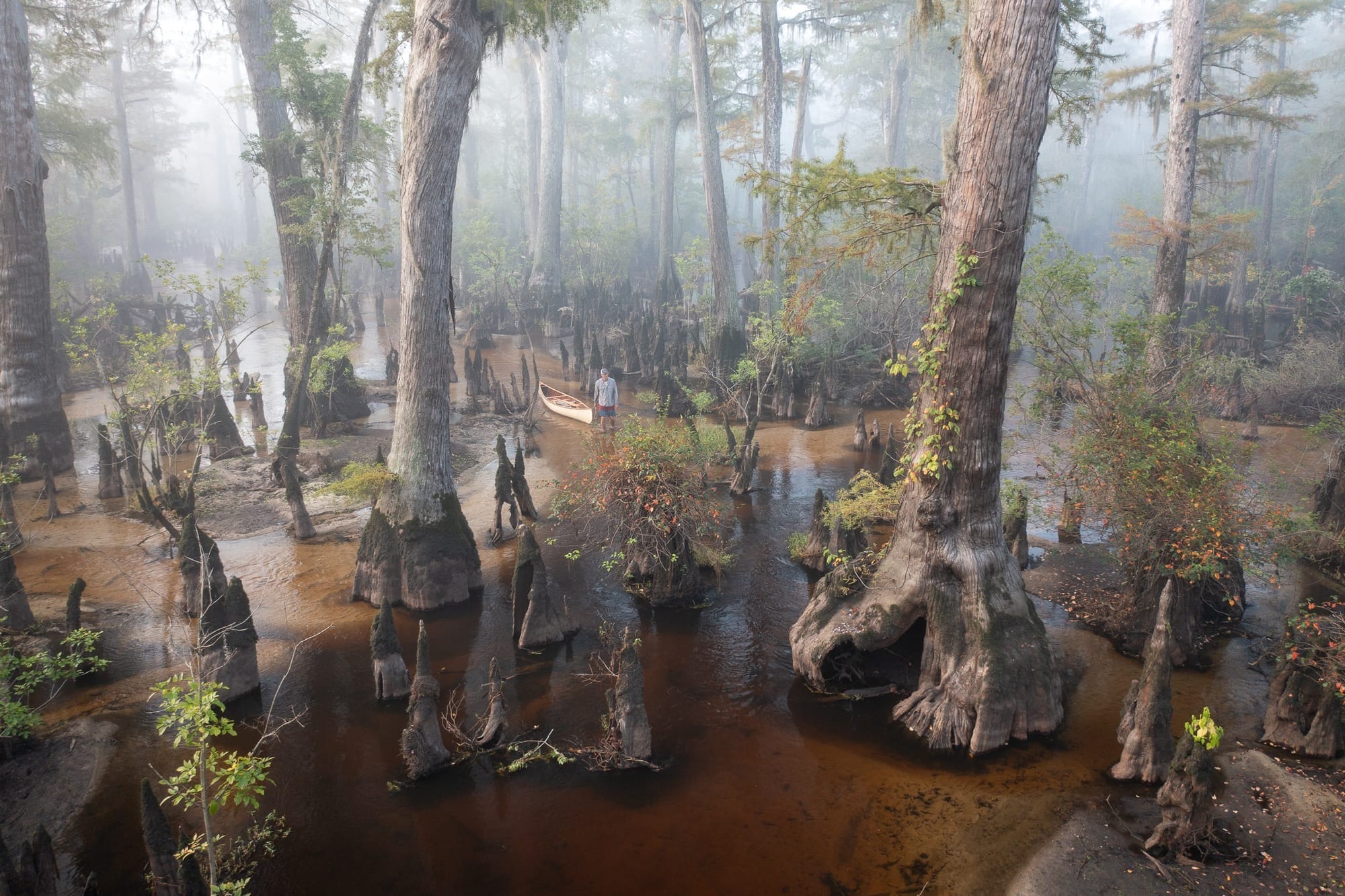
It was my first time ever being in an old-growth swamp, or knowing that an old-growth swamp was different from the second-growth swamps I grew up with. It was completely different. In a secondary or tertiary forest, you’ve lost the canopy, so you have all this young growth competing. In old growth, the understory is clear. You have big trees shading everything out, fields of cypress knees, blackwater running through, and an incredible amount of life.
Some of my earliest photographs from that swamp placed in international competitions, which was encouraging. I hope the attention helped bring new visitors to the forest that Audubon stewards. And that started this idea: I wonder if there are other old-growth swamps out there, and what they might look like. I took a long break, photographing all over the place, and came back to the project in 2017. I went to Corkscrew Swamp, and then the Black River, in North Carolina, and Congaree, in South Carolina, and I started thinking, Well, there’s actually something here. They’re all old-growth swamps, but they’re very distinct. They look different. The life there is different. The idea for a book came in about 2020. These places needed their spotlight. They needed to be seen by a bigger audience.
A lot of people would look at your work and think, What an enviable life — to be a National Geographic Explorer, to get to poke around and document all this. What’s the takeaway from your experience that might help others find their own path?
Before you walk through the door, you’re always on the outside looking in. Before I became affiliated with the National Geographic Society, I was the same way: Man, how do I get in? But I just kept plugging away at the things I cared about. It’s kind of like the 10,000-hour rule. If you spend enough time doing something you care about, people will begin to notice.
I applied on a whim for a National Geographic storytelling grant for this old-growth swamp project, which I thought nobody would be interested in. And they liked the concept: This is what the Southeast used to look like, this is how it used to function, and not many people know about these places. I’d always thought of National Geographic as being about far-flung places, places you need a passport to get to. But they’re also interested in hidden, semi-unknown wildernesses in our own backyard. To me that’s the most interesting thing — places that are accessible, places that can inspire people to think about their home in a different way.
It really was just knocking on the door and beating my tired swamp drum over and over and over again, until they probably just wanted to shut me up.
And from a craft perspective — any advice for someone who wants to capture the wild South?
It’s easier — maybe not easy, but easier — to go out and make single-frame beautiful images of wildlife or landscapes. The Southeast has a ton of those to offer. It’s much more difficult to put together a cohesive visual narrative. So that’s what I’d recommend. If there’s something you care about — oak-hickory forests, headwater streams of the Southern Appalachians, maritime forests, Florida springs, the biodiversity of the Mobile Bay basin — pick that story and work on it for a long period of time, until the visual pieces start to line up and fill it out.
If you’re trying to get people to care, or trying to get organizations to use your images to make a difference, a single frame isn’t enough. You’ve got to provide the visual assets to tell a story. Even though these places are all about ecosystems, it’s ultimately about people — getting people to connect. And people resonate with stories.
Photobooks so often strike me as just big ornaments — fancy objects to put on the coffee table. This book is so much more than that. What was your philosophy here? How did you aim to set it apart?
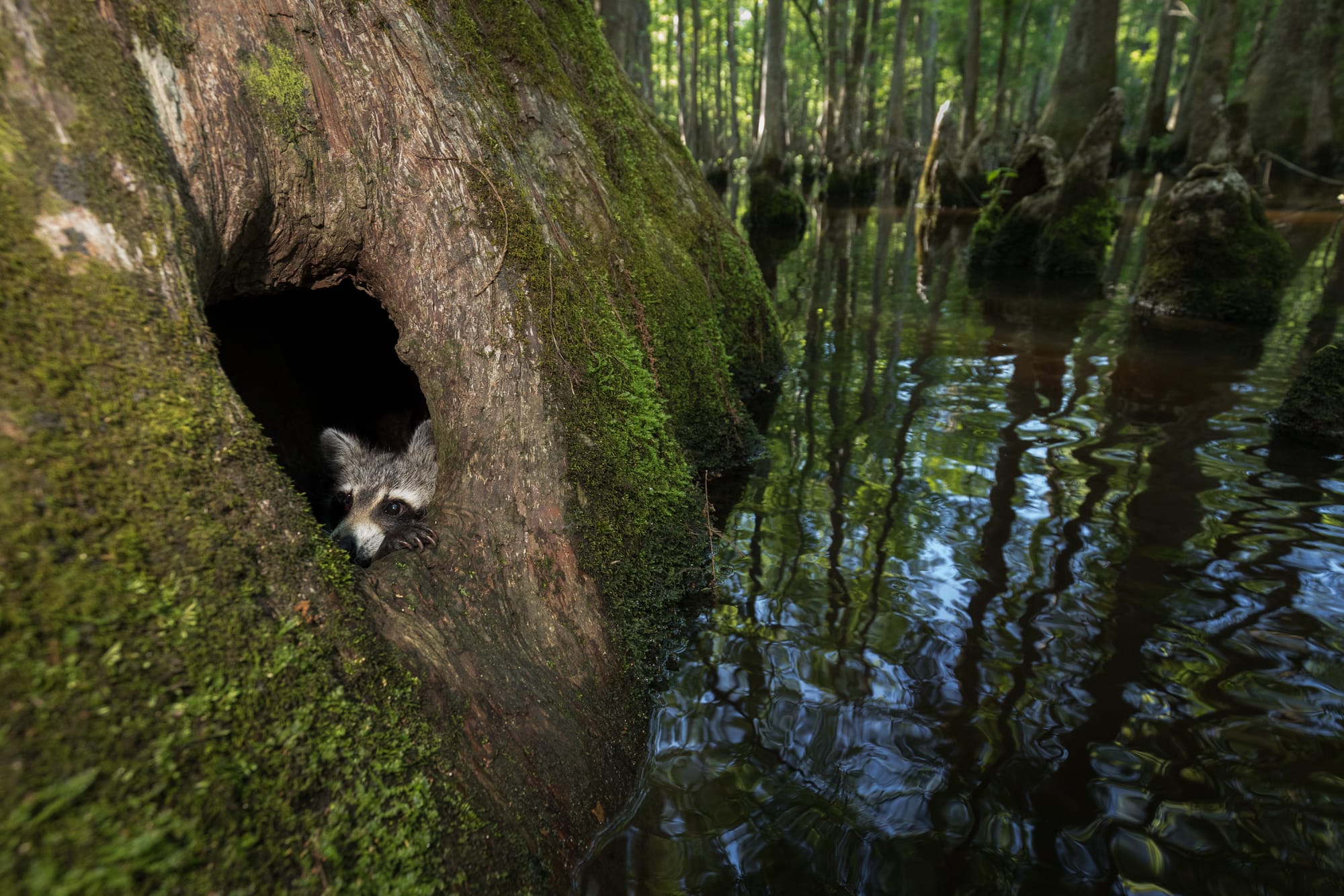
I put pretty strict boundaries on it. I have lots of images from all over the Southeast, but this book is meant to be a celebration of what is left after industrial logging came through and rapaciously logged pretty much all of our Southern wetland forests. So I set a creative boundary: I’m only going to document old-growth swamps of 100 acres or more. I didn’t want to just photograph old trees and have the book be about singular, iconic trees. I wanted it to be about living, working, breathing forests and all their connections — the mushrooms, the raccoons, the panthers, the bears, and all the ways these animals interact within the forest.
In a way that makes it harder. You’re beneath the canopy most of the time, so it can be dark. But it also allows a ton of creative freedom. You can do macro, you can do landscape. There are a lot of camera-trap images in this book, which took a ton of hours — setting cameras out in the field and leaving them up for years in some cases, with a lot of failures. But because of those guardrails, we could take a really deep dive. What’s most exciting to me is to nerd out about the details — all the little intricacies that make these forests unique and special.
That explains why the Cat Island bald cypress isn’t in the book. I visit that tree every year, but it made me realize I don’t know that I’ve ever been in an actual old-growth forest. One great tree isn’t a forest.
That’s it. And that’s not to say that tree isn’t special. I had people reach out and ask, How could you not cover the Atchafalaya, or the Great Dismal, or the Okefenokee? Well, all those places were logged. Yes, there are old trees left, but the forest — old enough to function as it has naturally for millennia — just isn’t there. I’d love an excuse to make this as wide as possible and just talk about swamps. But this book is about the last old-growth swamps. There are a handful I didn’t get to, but only a handful. There just aren’t many tracts left.
The ones I chose, I chose for what lives there and what they represent. Beidler Forest and Congaree are both in South Carolina. Congaree National Park is 26,000 acres, but only about 300 of those acres — like a little square stamp — were never cut for cypress. It’s on the Congaree River, which deposits massive amounts of sediment throughout the floodplain. So those trees are younger than the ones at Beidler, but they’re huge because of all the nutrients. The trees on the Black River are significantly older — 2,000, 2,600 years old — but they’re starved of nutrients, so they’re smaller. And then Corkscrew is different from all of them, because it’s near the tropics. You get orchids, bromeliads, all that.
If someone wants to experience these places, where should they go?
The awesome thing is that these are all protected, and they’re extremely accessible. Corkscrew Swamp has a 2¼-mile boardwalk. Beidler Forest has a 2¼-mile boardwalk through the swamp. Congaree has loads of trails. The Black River in North Carolina is accessible by canoe and kayak, and you can hire guides. So if you live in the South, look at a map. If one is within a few hours’ drive, go. These places are like the Mona Lisa. They’re the benchmark for how these forests looked — for what a swamp should look like. Before you book any other trip, go see them. They’re truly stunning.
In our third issue, David Walter Banks has a photo essay from Dead Lakes, Florida. He doesn’t manipulate his images digitally, but he brings colored light into the swamp — he compares the effect to magical realism. His essay on his craft makes me wonder how you balance making an arresting image with capturing what’s really there?
I love his work. That opening spread, the red one — I messaged him after I saw it: “We’ve got to hang out.” For me, too, I can’t say that what I do is all analog, or 100 percent real. I mean, it is. But I’m also adding strobes to pop light, to catch light in the eyes of snakes and turtles, and putting out camera traps with six strobes to create a kind of outdoor studio that shows off the landscape and the animal in it. The only difference [between me and David] is that I’m not putting colored gels on them.
My approach on most of this was: How do I make the quintessential images of these places, so that people will see them the way I do — with this reverence and appreciation? I try to photograph in a way that spells awe and wonder, and that helps people get to know animals that are historically thought of as scary, spooky, creepy-crawly — to show them in a way that’s more accessible and more illuminating.
What’s next for you?
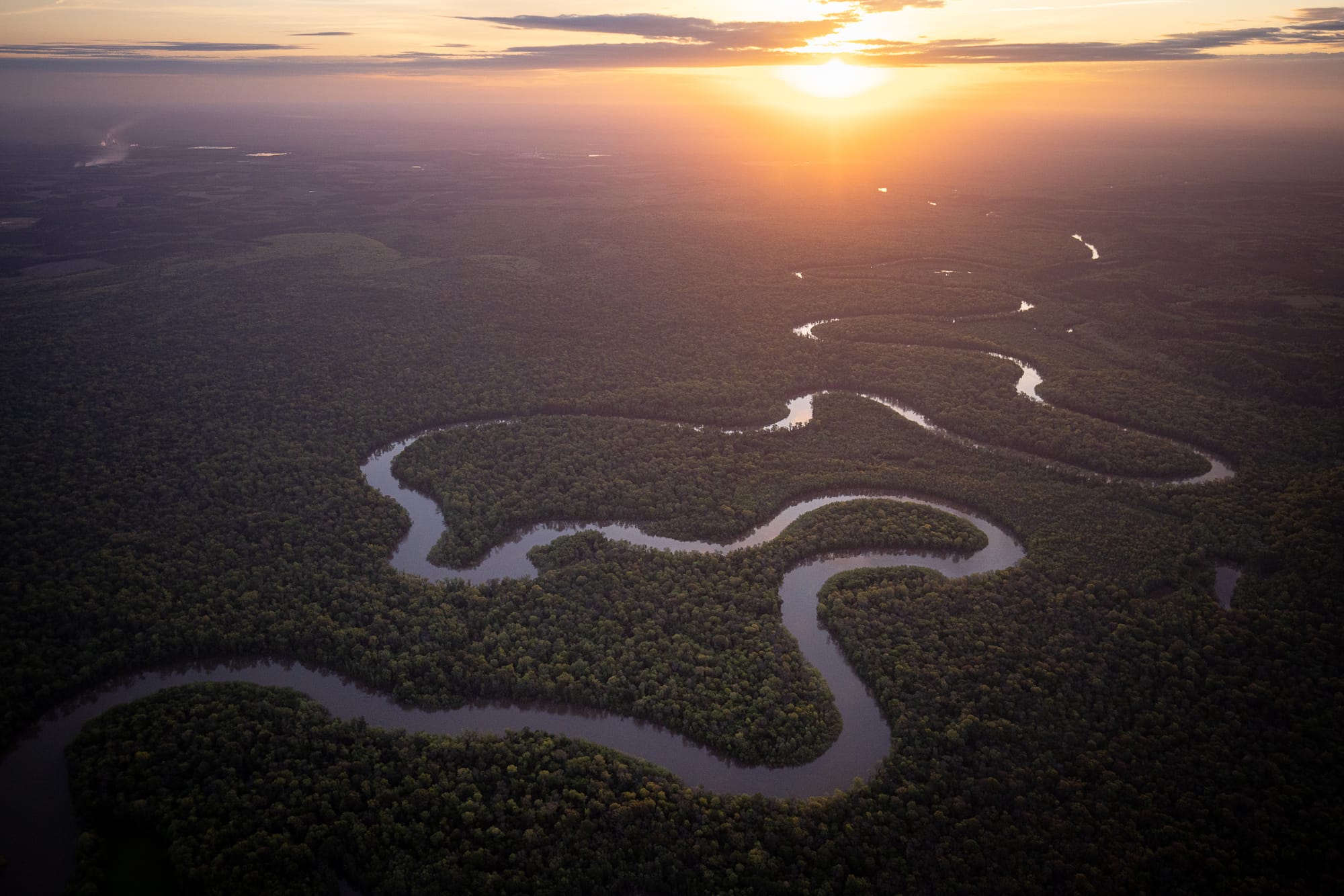
We have an IMAX film premiering next month, American Amazon, with a companion book of the same name. It’s about celebrating the larger Southeastern landscape. We’re taking this approach of removing state boundaries and looking at the Southeast as a living, breathing system connected by water — deltas, forests, headwaters, the Mobile Delta. After that, we’re working on another IMAX film, about the Everglades. We’ve been filming for the last year, and we’ll be filming all next year as well.
Signed copies of Cypress are available at Mac’s website.