


Our second issue, PUBLIC/PRIVATE is now shipping! Over the coming weeks, we'll be publishing new stories from the issue on Thursdays. Not every story will become available to read for free, so if you'd like to access the full issue, you can buy a copy in our shop or subscribe.
This essay is excerpted from Spare These Stones by Andrew Kornylak. Published by Mountaineers Books (August 2025). All rights reserved. Used with permission from the publisher.
On a map, start at Atlanta, Georgia, and trace a route northeast to Boone, North Carolina. Then go up to Lexington, Kentucky, on down to Birmingham, Alabama, and then back to Atlanta. This heart-shaped region, along with Chattanooga, contains more climbable rock than any other metropolitan area in the United States.
The physical scale of Southern climbing is easy to wrap your head around. Most walls are one hundred to two hundred feet high, and you can find them damn near everywhere, once you know how to look. There is a familiarity and intimacy with the local climbing that is harder to feel in bigger mountain ranges. Southern climbers find their stone not on a remote peak but at the end of a road in the backwoods.
Owing to that, even the wildest landscape here seems entangled with the presence of man. Turning one corner reveals stunning and rare natural beauty; around the next, a junkyard. It’s an ancient presence too. As you unpack your climbing gear under the dripline of a massive sandstone roof, you may find a spear point and realize the last human drama played out here at least a thousand years ago.
Southern rock is so plentiful and high quality that anyone with a little time on their hands can revel in their own secret area. For climbers who have traveled enough to know how rare that is, there is an irresistible urge to share the miracle of Southern climbing with the world. Usually, those two impulses are at odds, but sometimes, they are embodied by the same people.
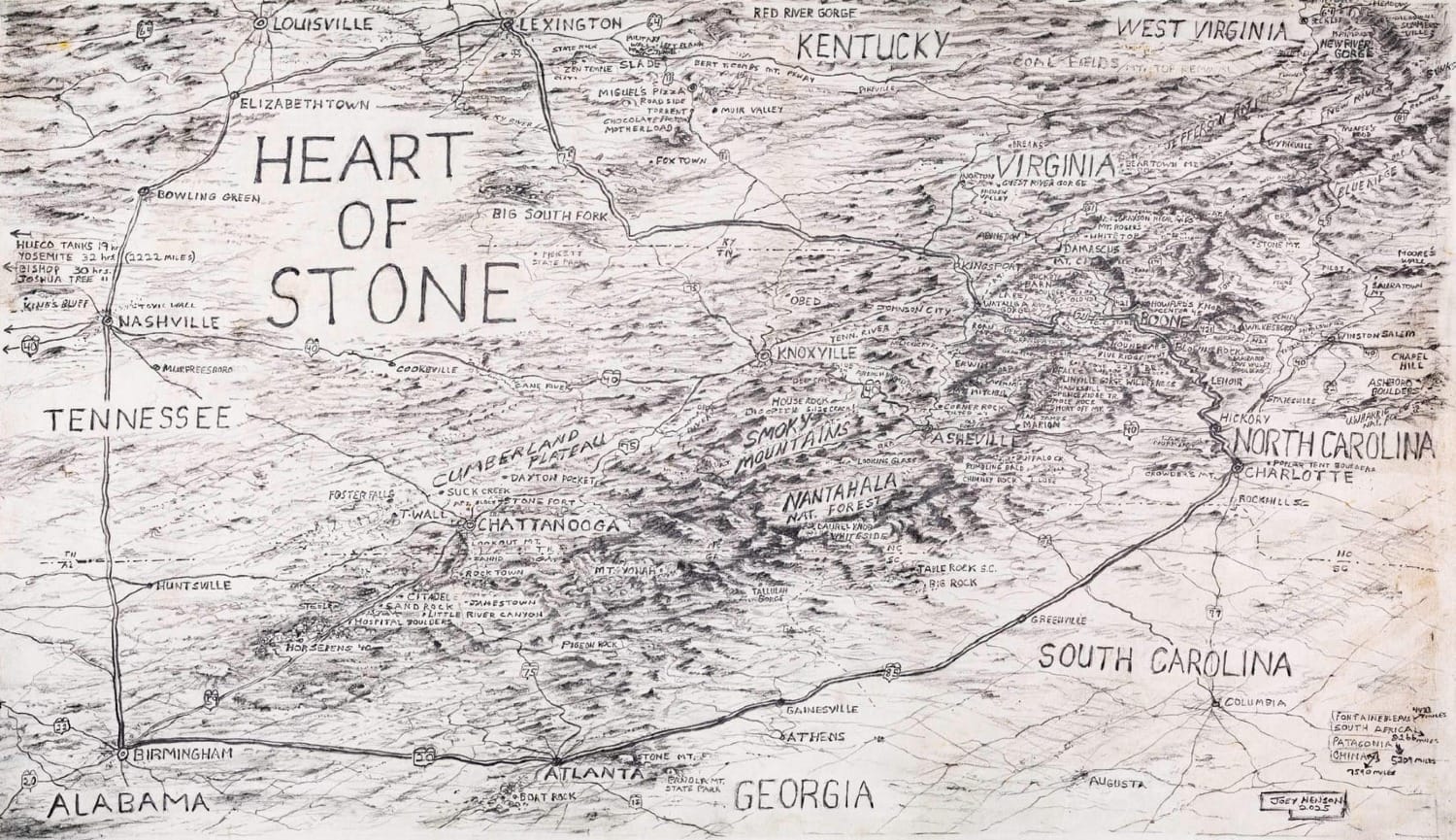
Much of it remains unexplored for climbing owing to lack of permission. Overlaying property lines reveal a patchwork of land ownership. Most of this climbing is on private land, with some state and federal management mixed in. Around the 1970s and ’80s, to the average Southern landowner, climbers were at best trespassers on par with four-wheelers and deer poachers. Access was held by a select few and shared by word of mouth. If you were lucky, you had a face-to-face conversation with a guy in a truck, traded him a twelve-pack of Bud Light, and he’d let you and your friends do your thing on his cliffs. Eventually, someone would screw it up by wandering in unannounced on a Sunday or—God forbid—publishing a picture of that fellow’s back forty in a magazine, and next time he’d return with a shotgun.
This post is for subscribers only
Subscribe now and have access to all our stories, enjoy exclusive content and stay up to date with constant updates.
This is not a paywall
You can read this story for free, once you sign in.