
I was introduced to the Chattahoochee River on my daily commute. Even before I knew it supplied my drinking water — and 5 million others’ in the Atlanta Metro area — I purposefully turned to admire the dark green, tree-lined river as I zoomed (or crawled) over it on the interstate. This daily glimpse was a dose of calm for a newcomer in a sprawling city.
Over the next decade, while working as a land development engineer, I learned about the exacting constraints placed on the Chattahoochee. How its flow is wrangled through dams and reservoirs, divvied up between Georgia, Alabama, and Florida by contested water control plans that have escalated to the Supreme Court. How threats to its water quality were only mitigated after decades of grassroots advocacy led to still-imperfect environmental regulations. Recently, as I’ve navigated burnout and a career transition, a friend suggested I visit the river’s source. Intrigued, I wondered if I would still recognize the overburdened body of water at its point of beginning.
I embarked on my pilgrimage a week after the Spring Equinox. Turning off Highway 180 at the Chattahoochee National Forest sign, I parked in the gravel strip along the road heading north to Brasstown Bald. I shouldered my pack and crossed the pavement, finding the steep trail zig-zagging between sectioned logs. Soon I’d ascended several hundred feet, following Jack’s Knob Trail south along Hiwassee Ridge.
When I left Atlanta that morning, the streets were ablaze with springtime blooms. Here, up in the southernmost tail of the Blue Ridge Mountains, the trees weren’t yet ready to clothe themselves. Through the bare branches, I could see a hillocked horizon of gray and blue mountain slopes. Down at my feet, though, were abundant signs of new growth. Dozens of trilliums were emerging from the leaf litter, their dark green, trifoliate leaves rimmed in deep purple. Candy-green mayapple leaves formed miniature umbrellas. A grasshopper bounded noisily across the path, playing a near-invisible game of hopscotch. I gazed across the dramatic fold of the ridge, a natural boundary between watersheds. Rain falling to my left and right would follow completely different paths — winding either north and west toward the Mississippi (via the Tennessee and Ohio) or south along the Chattahoochee.
Named by the Muscogee (Creek) people for its white-streaked rock formations, the Chattahoochee itself has served as both a dividing line and a thriving cultural center for Indigenous peoples, from ancient Mississippian mound-building chiefdoms to the loosely linked Native American communities living along the Southeastern river valleys after Europeans arrived.The 1821 Council Bluffs Treaty used the upper reach of the Chattahoochee to divide what land the Muscogee and Cherokee still held after decades of settler incursions. By 1835, a blitz of armed conflicts, racist policies, economic forces, and hastily-negotiated treaties forced the tribes to cede all remaining territory along the river to the United States government. But their name for this river was so well-ingrained that it could not be wiped from the maps.
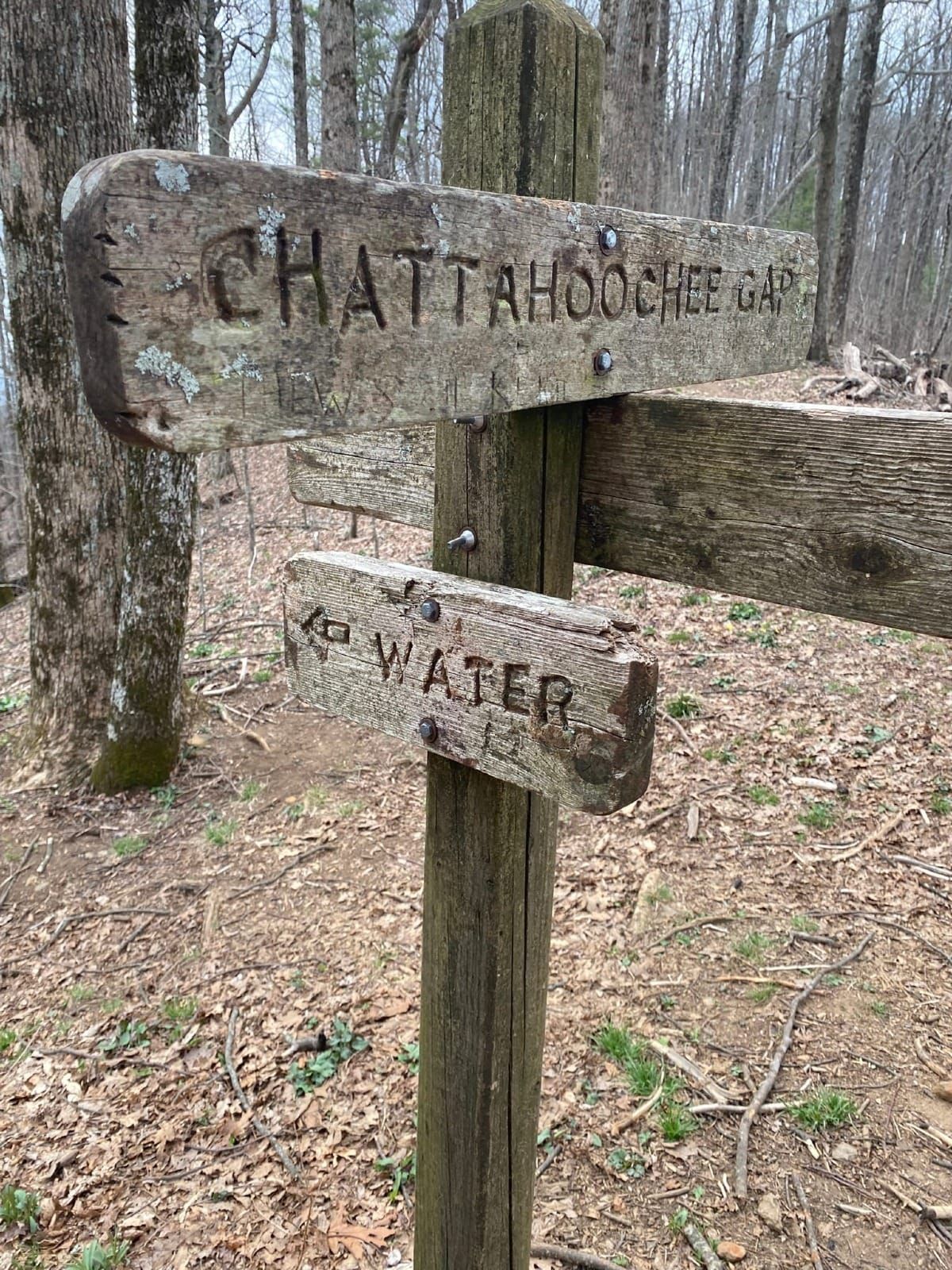
As the ridge tapered to flush, I approached a group of through-hikers resting at the Appalachian Trail crossing. A small wooden sign pointed to “water.” Nearby, a blue paint stripe on an old tree marked a turnoff from the main trail: a narrow, hardly worn path on a severe slope. According to my phone, I was close.
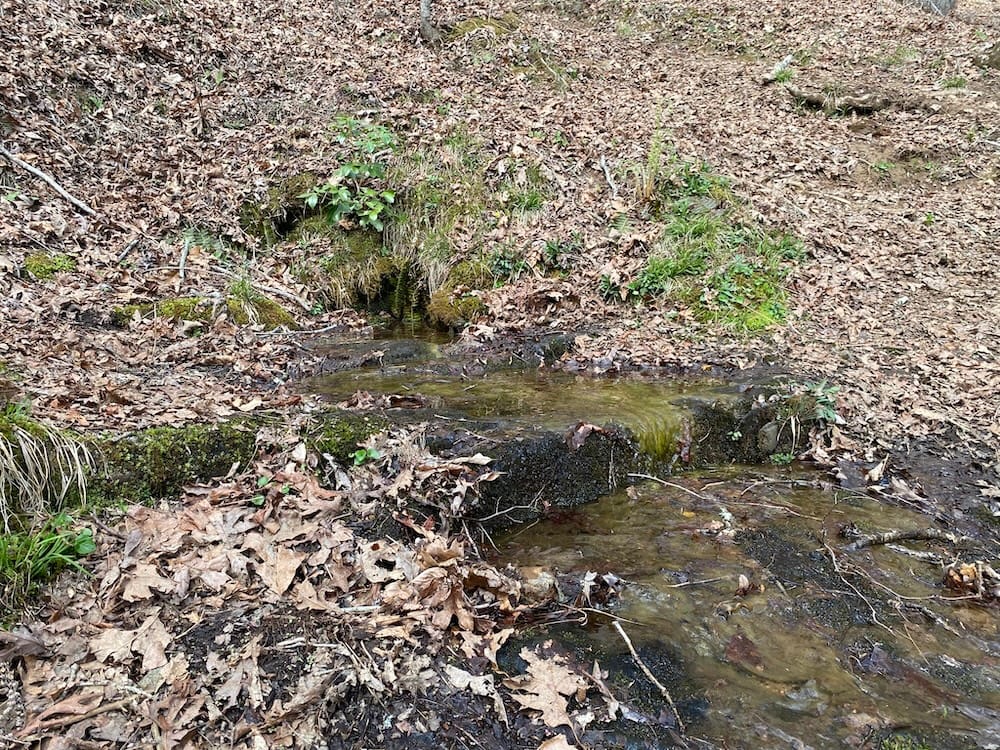
A couple hundred feet down, nearly buried by fallen leaves, I found a patch of glistening mud in the crook of a collapsed bank. Crouching, I lowered my face to inspect a slow drip from a mossy rock. Like the tiny overflow drain in a bathroom sink, this, I knew, was the spillover from a larger well stored in the mountainside. It was not uncommon as far as springs go, but, knowing where it led, I felt the pull of kinship.
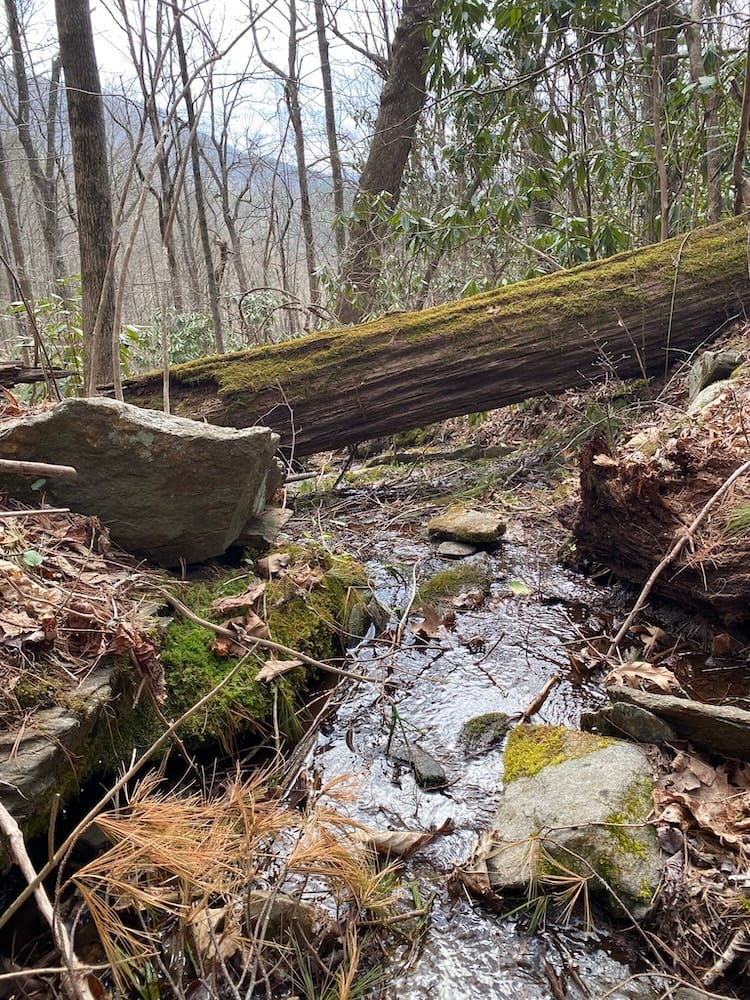
A few strides further, the tiny drips disappeared below tree roots. I followed the channel downhill — the blazed path gone now — climbing over branches and around thorns. Then I saw water bubbling from beneath a rock, forming a rivulet past sunny daisies and then over a several-foot drop. Just a stone’s throw from its unassuming source, the Chattahoochee had enough energy to sing.
I found a place to sit where the water flowed along the crevice of a rock face, sheltered by mountain laurels. After removing my backpack, shirt and shoes, I listened to the cascading stream and relaxed in its cool temperature. This secluded spot reminded me of a tree downstream, where I used to sit in its branches to journal after work, trying to find my literary voice. But amid the headwaters’ tranquility, I felt a sliver of sadness, too, a deepened appreciation for the river’s fragile beauty and its beleaguered march to the sea. I couldn’t help but think that somehow the flowing liquid, ever recirculating, must know the obstacles ahead: sewer spills, cleared forests, urbanization. Even so, in the Chattahoochee’s soft song I heard a hopeful ballad. The river is just beginning again here. The future is yet to unfold. In its melody, there is room for us to harmonize.
Joseph R. Goodall is a writer and civil engineer whose fiction, essays, and poetry explore the intersection of human communities and natural landscapes. He is the author of the historical fiction novel-in-stories, What the Bird Sees in Flight, and writes an online nature journal, A Walk in the Creek.