

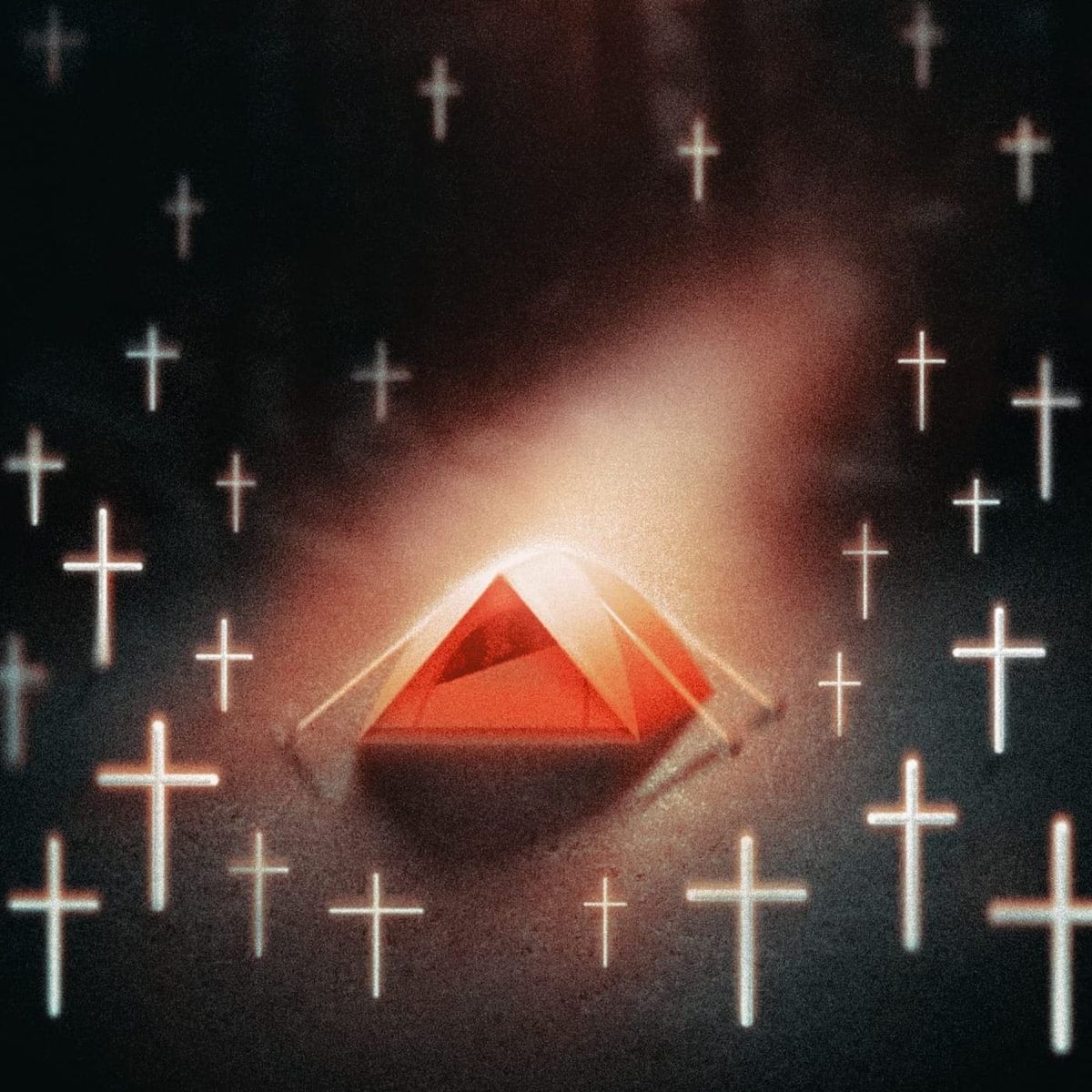

Our second issue, PUBLIC/PRIVATE, is now shipping! Over the coming weeks, we'll be publishing new stories from the issue. Most will be behind a paywall, so if you'd like to access the full issue, you can buy a copy in our shop or subscribe.
The stranger invaded our camp just before dark. It was me and my eight-year-old son Fisher out there, alone together in a remote corner of the primitive area of Tishomingo State Park—a rocky woodland in the northeast corner of Mississippi, foot of the foothills of Appalachia, with the leaves burnished orange and brown on a Friday in early October.
The pickup barreled through the parking lot where we’d left our old Subaru, blew past the “No Motorized Vehicle” sign, and came jouncing toward us, dodging trees and fallen logs until it rested in a cloud of dust a few feet from our tent.
Some over-zealous campground host, I assumed, come to introduce himself and make sure we hadn’t lit any fires.
That was the tail end of a long, hot dry spell. Not a drop of rain for going on two months. The forecast was calling for showers over the weekend, but they hadn’t arrived yet. Until they did, campfires were forbidden.
Maybe that’s why the park was strangely empty for a weekend in fall. That morning, it had felt like a good omen: We’d passed a few rust-gnawed RVs backed into the established sites down by the lake, which had receded so far that the fishing piers stood on cracked ground. The air had a sour, muddy reek as if all the fish had died of heat stroke. Ours was the only vehicle in the primitive lot, ours the only tent in sight, a fact that pleased me.
I’ve known social campers. I’ve always been a backcountry guy myself. This love was a big part of what I wanted to pass on—the solace of that contact with the more-than-human—but Fisher was eight, asthmatic, and had never shouldered a pack. The primitive area seemed like a place to start.
We spent the afternoon rambling, hiking a big loop that crossed and recrossed Bear Creek, wound up through an abandoned homestead, then back around stands of hickory and oak, without meeting another hiker.
All down the afternoon, I’d felt the hard knotty rope in my chest uncoil more and more. It was good to be in the woods. Good to be alone in the woods with my son. There were things I needed to say to him that I hadn’t yet found words for. I loved him with a big aching love that could gut punch me on occasion. At the same time, when I looked at him, I couldn’t help seeing myself at his age. And I’d hated myself at his age, plagued as I was by a scrupulosity borne of a rigid fundamentalist upbringing—an unattainable standard of moral and bodily perfection. I’d grown up feeling weak, ugly, and inadequate, riddled with unseemly desires, petty resentments, and unsightly pockets of fat. I didn’t want him to feel like me. Didn’t want him to be like me. I wanted him to be better but wasn’t sure how to help without passing on my old compunction. I’d been doing some work, learning to love and accept the boy I’d been, and I wanted to offer him this and more. But I could not, for the life of me, think where to begin.
A campfire would have helped. What is it about a good fire? The sight and smell seems to invoke some primal impulse for connection which in turn has a way of deepening the currents of conversation. Or maybe it’s just easier to talk when you have something else to stare at.
The thin blue flame of a camp stove was a poor substitute but would have to suffice. We ate our chili, and then, as dusk deepened, I stirred hot chocolate and improvised s’mores, roasting our marshmallows over the gas flame. “Sorry there’s no fire,” I said, though Fish hadn’t complained.
He grew thoughtful, nodding, then pointed out that at least we’d be able to see the stars more clearly. He tipped his head back, and I followed his gaze to the night sky, where the first pinpricks of light had begun to appear.
Guided by those stars, I was working up to a story about how difficult it had been for me at that age—how alone I’d felt and how I was here for him—when the stranger’s headlights appeared, blinding me and making shipwreck of whatever I might have said. He might as well have parked his truck between us.
As he climbed out, I called a greeting.
Twitchy, the man kept glancing over but said nothing, only lowered the tailgate and rolled out a sleeping bag in the bed.
The light was poor and my eyes were dazzled with spots from the headlights, but I could see he was clean-cut, mid-thirties, sporting a lime-green polo tucked into chinos.
I asked Fish if he wanted another s’more. More hot chocolate? But he was preoccupied now, too, watching the man.
This post is for subscribers only
Subscribe now and have access to all our stories, enjoy exclusive content and stay up to date with constant updates.
This is not a paywall
You can read this story for free, once you sign in.