

North Carolina-based writer Michael Venutolo-Mantovani reached out to us recently to see if our founding editor, Boyce Upholt, might want to sit down for the first episode of his new podcast, The Itinérance, in which travelers discuss their best-ever day. We hope you'll check out the interview, and everything else on offer at The Itinérance. To accompany the episode, we asked Michael to write about a good day of his own in the Southlands. He offered this dispatch from the Boone Grand Fondo.
Normally, vision is the one sense you want when riding a bicycle down a mountain. Touch feels the road beneath you. It can even sense a storm coming or let you know when your body is on the verge of overheating. Your ears alert you to other riders gaining ground on your back wheel. But sight lets you know just about everything else: the location of the apex of each winding turn, whether there’s anything downhill you need to avoid, and, most importantly, the existence, location, and closing speed of any oncoming traffic.
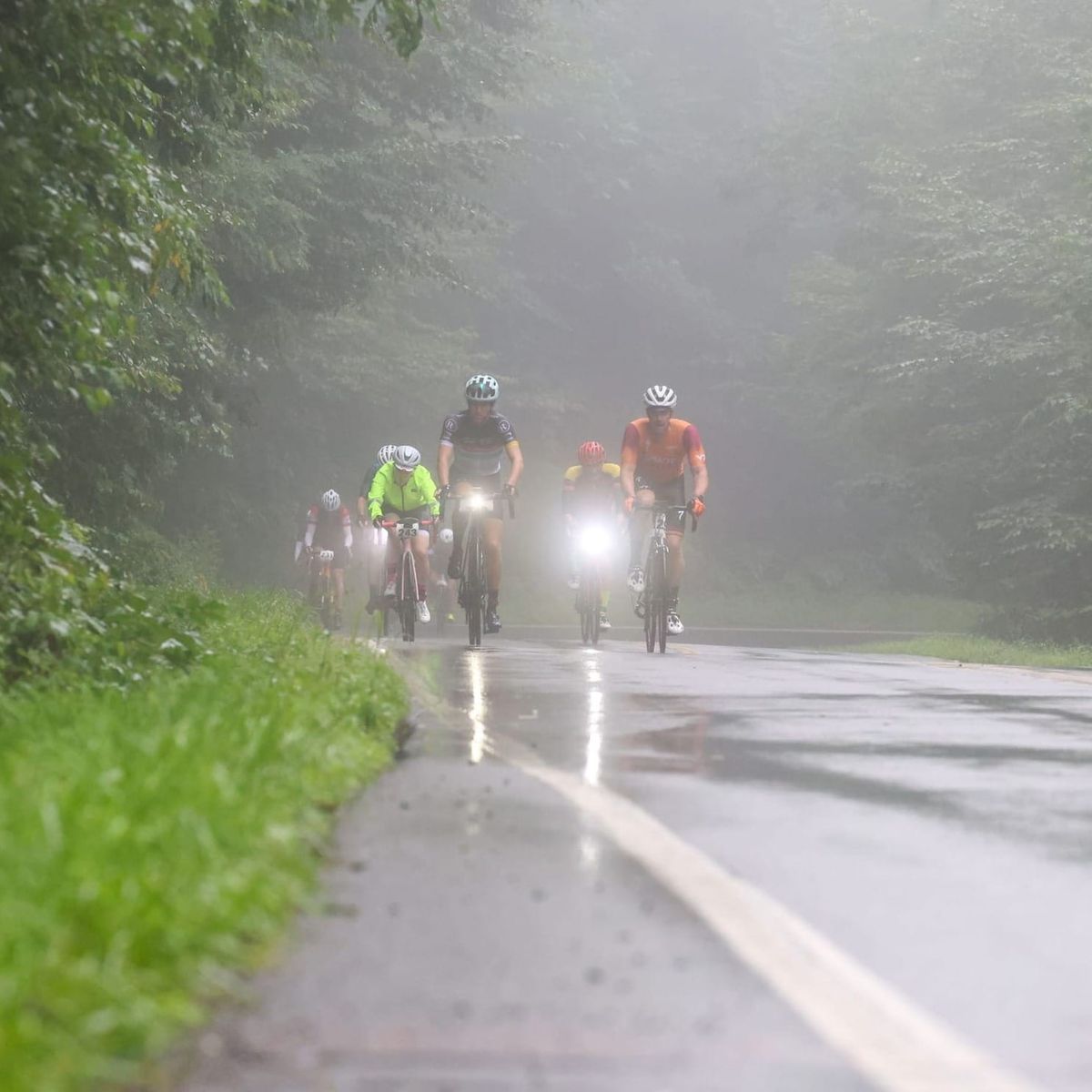
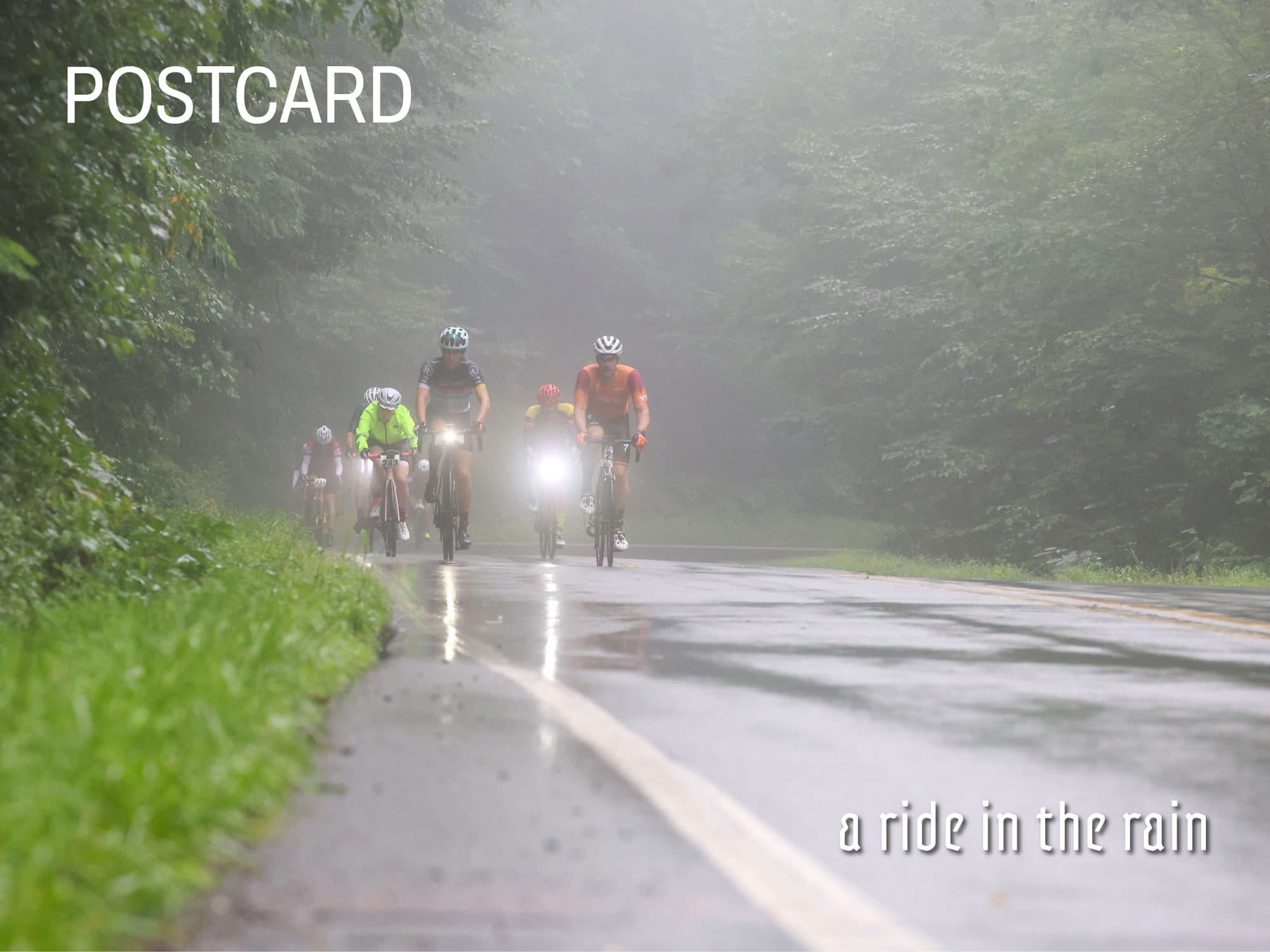
However, on the morning of this year’s Boone Gran Fondo, which took a few hundred amateur bike riders nearly eighty miles, climbing nearly eight thousand feet around Boone, Linville, Blowing Rock, and countless other tiny towns, hamlets, and hollers in the mountains of western North Carolina, thick sheets of rain and dense mountain fog rendered visibility almost nil. Barreling down descent after slick descent, my rain-specked sunglasses tucked into the ventilation holes on my helmet, I saw, at best, thirty, maybe forty feet ahead of me.
But, in a weird way, the lack of sight for much of the day forced me to connect with the landscape in ways I never had before on a bike. Rather than intently staring downhill, searching for those potential pitfalls, my eyes drifted to the sides of the roads, searching for the beginnings of little bends in the white and yellow lines, indicating entry to a gentle (or not-so-gentle) curve. It was strange, in a way, to try to see the road preternaturally as opposed to seeing it for exactly what it is; to try to use the knowledge gleaned from the hundreds of thousands of miles I’ve logged as a road cyclist to portend what might come next.
Of course, focusing on the sides of the roads rather than the roads themselves came with its own set of potential hazards. Stunning waterfalls suddenly appeared, as the rush of a deluge cascaded over the giant boulders jutting out above the roads — boulders that always remind me that these roads, this brilliance of human ingenuity, were cut into these mountains by the hands and minds of men. Or — maybe a better way to put it — they were cut out of the mountains.
The rain, harrowing as it was at times, forced my attention off the road itself, tuning it to the natural world around me.
As an avid roadie, when I'm not looking down the road, my focus is too often trained on the little three-inch LCD display mounted to my handlebars, the little bike computer that tells me how much power I’m making at any given second, how many times my pedals are rotating each minute, how fast I’m going, the average speed of a day’s ride, and, most importantly in the mountains, the grade of the climb I’m struggling to surmount. But when weather complicates a ride and the most important sense is inhibited, my focus shifts to a much narrower lens, one that can better see the world closest to me.
The Boone Gran Fondo was an amazing ride. The perfect mixture of brutal climbing, rolling roller-coaster-like segments, and blow-your-hair-back descents, it was the most fun I’ve had on a bicycle in some time. But it's the rain that’ll stick with me longer than any other memory of the ride, the sheets of water that made me look at the world around me a bit more closely and stop focusing so far down the road.