
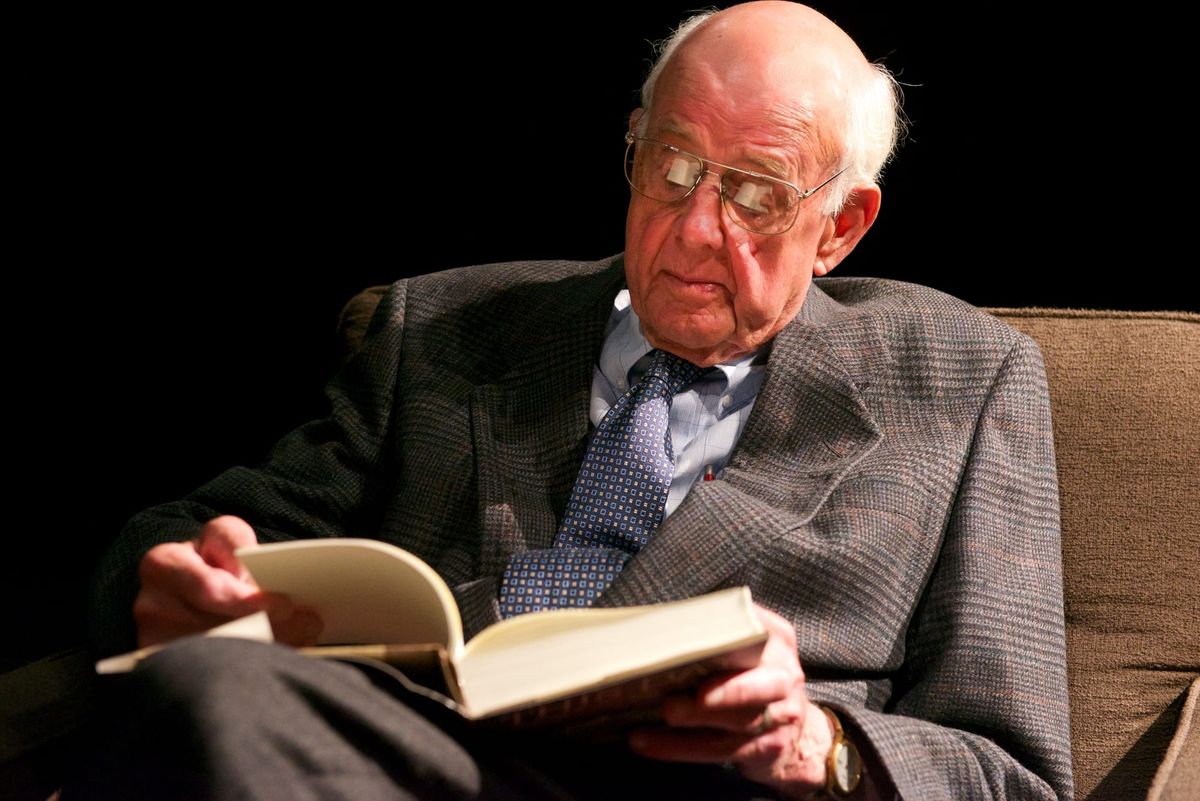
For days, since hearing the news of Wendell Berry’s dying, I’ve been fumbling to understand and articulate why I feel so bereft. It’s not as though I had anything like a personal relationship to lose and feel the lack of now. I never met him except through the portal of intimacy his writings opened. Still, it feels like I’ve lost a father.
That is a clumsy and presumptuous way of putting it, but one that recalls a passage from The Need to Be Whole, where Berry explores the reality that “there are myriad instances and examples when understanding precedes knowledge.” He goes on to propose what we might call an epistemology of envisaging love, suggesting that “we know in the fullest sense only what we love and…we love and know in the fullest sense only what we have imagined.”
Loved, yes. And also imagined. It’s fair to say that I have imagined and loved Berry as a kind of spiritual father, whose exemplary life has played a major role in my own formation. (Exemplary? To be sure, though with apologies, as I can well imagine how the old contrarian might bristle and object to such a charge.) All week I’ve been skimming the underlined, annotated, tea-stained pages of long-cherished books, looking for a way in. Where to start? How can I begin to convey how his writings have shaped my life, blessing and enriching me in ways he’d never know?
Conceived in a drunken Mardi Gras revel in New Orleans, I was born in Miami; celebrated my first birthday in Little Rock, Arkansas; had, with layovers in Fayetteville and Pine Bluff, arrived in Baton Rouge by the time I turned two; and moved east from there to a then-unincorporated community called Diamondhead on the Mississippi Gulf Coast before I was three. As best I can tell, my parents’ marriage had been a shambles almost from the start, and all that frenetic motion derived from their spurious faith in what I’ve come to call the geographic cure: the groundless belief held by so many of us transient Americans that getting to a different, better sort of place will somehow make us different, better sorts of people.
Of course, that awareness came later. I was too young to remember much of what I thought or how I felt at the time, but that serial uprooting seems to have left an indelible mark, generating some fierce dissonance between an overwhelming longing for home paired with a chronic restlessness that’s kept me hypervigilant, forever alert for the nearest exit.
By the time I was four, we’d arrived in the small town of Mendenhall, Mississippi, where my mother grew up, and where we’d remain, cycling through different houses for a while. Then, after the final rupture gave way to a strangely amicable divorce, an insanely convoluted custody arrangement — Sundays at Mom’s, Monday through Wednesday with Dad; Thursdays and Fridays with Mom; back with Dad on Saturdays — meant my siblings and I toggled between houses, living mostly out of duffle bags and never quite feeling settled anywhere ever.
I could go on to recount how, during my first four semesters of college, I shared five separate dorm rooms with a succession of six roommates — or how the early years of my marriage were dogged by move after move and included a several-months-long period where we lived out of a Subaru Forester, which we drove around first the Rocky and then the Smoky Mountains in search of some tenuous ideal. In that regard, without meaning to or wanting to, I fell in lockstep with the unhealthy pattern Berry describes in The Unsettling of America, continuing “with increasing haste and anxiety, to displace [myself].” I did this even as I valued — and chased — the dream of having arrived, of staying put, of feeling grounded by secure attachments to a particular patch of land.
In Marce Catlett, the final installation of the Port William Membership series, the narrator describes how Marce’s son Wheeler felt “the force of a story” on account of which “there were some kinds of man that [he] could not be, a certain kind of man he had to become, and certain things that he had to do.” This comes close to conveying the effect Berry’s body of work has had on me.
Since first encountering Berry’s writing in my early thirties, I have continued to feel the force of it as a kind of insistent demand. While I never had the honor of meeting him in person, I had a conversation with his daughter Mary a couple years back. In trying to convey the ways her father’s influence has altered the course of my life, I described how my apprenticeship to his writings led at first to a sort of crisis. I understood I had a choice to make: either stop reading these books or change my life.
That change has taken various forms, imposing a host of limits and requirements, inclining me at all times toward an ever-deepening inhabitation of this place where I’ve found at last a sense of rooted belonging. In more practical terms, that’s included, among other commitments and involvements, the founding of a community garden and the ongoing rehabilitation of a farmstead degraded by “the stampede of machinery and chemistry” which have characterized conventional agricultural practice since the second World War. In a more general sense the shift has infused all the ways I approach my life and work, aspiring to write with dirt under my nails, as the Dark Mountain manifesto puts it, and cultivating the elusive “Sabbath mood” Berry describes as the measure of what it means to “work well.”
For all its challenge, Berry’s writing has offered far more by way of comfort and encouragement, inaugurating an engaged process of healing that continues to address some of the oldest, hardest hurts of my dislocation, inviting me once more into what the great man often called “the membership.”
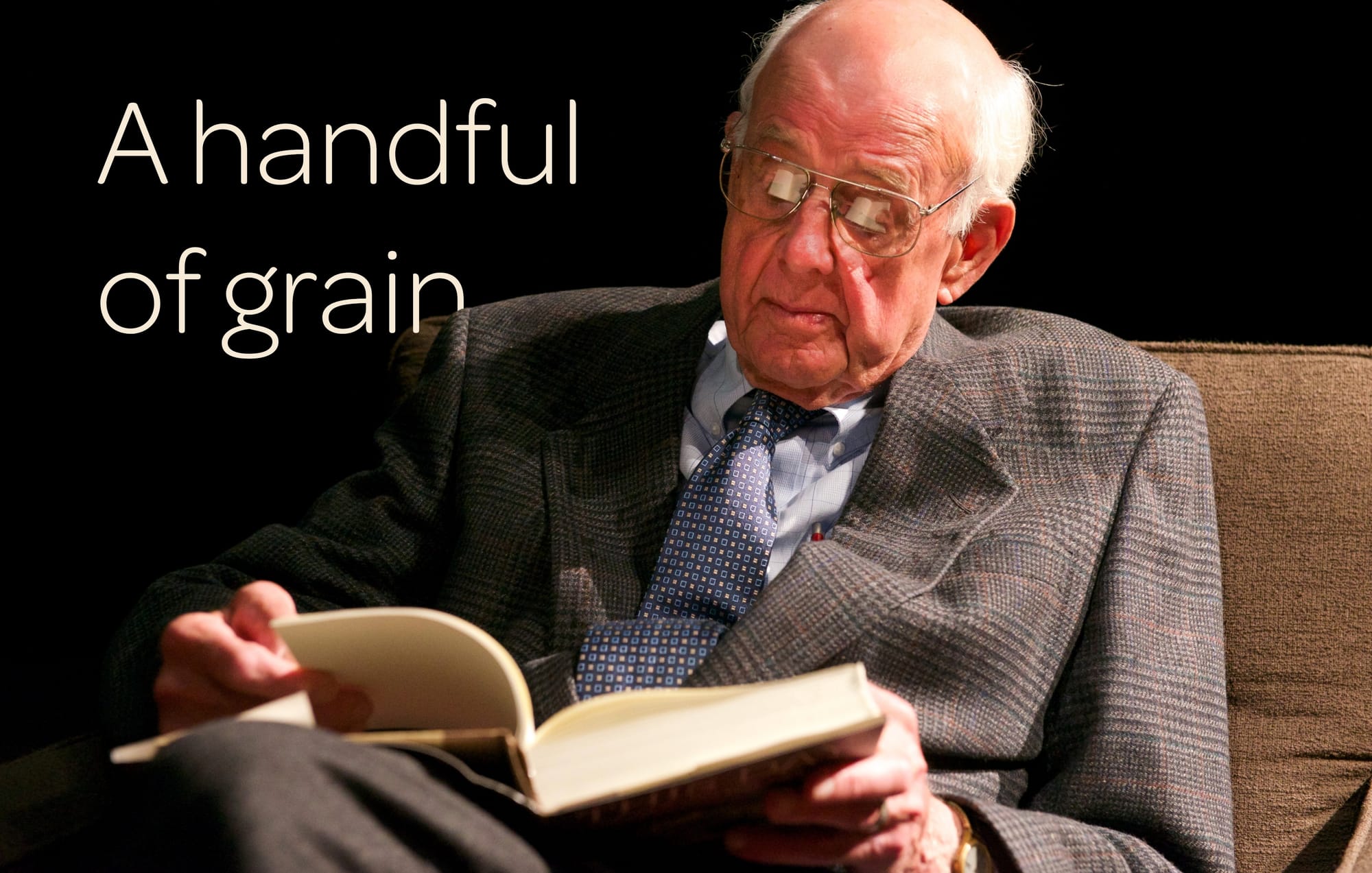
As Jayber Crow puts it: “Telling a story is like reaching into a granary full of wheat and drawing out a handful. There is always more to tell than can be told.” Always more, yes. I could go on and on, recollecting how this or that poem or essay or novel gripped me and shook me with its weird admixture of conviction and consolation. Elsewhere, Berry reminds us that “Stories come from stories and lead to stories;” that “every story has a context, and every context has a context” so that “the whole truth of such complexity cannot honestly be comprehended and explained.” And yet, something compels me to make the attempt now. Painfully inadequate as it seems, struggling to hold this gratitude in grief in tension, I draw out this single handful of grain in honor of the unspeakable gift.