

Our second issue, PUBLIC/PRIVATE is now shipping! Over the coming weeks, we'll be publishing new stories from the issue on Thursdays. Not every story will become available to read for free, so if you'd like to access the full issue, you can buy a copy in our shop or subscribe.
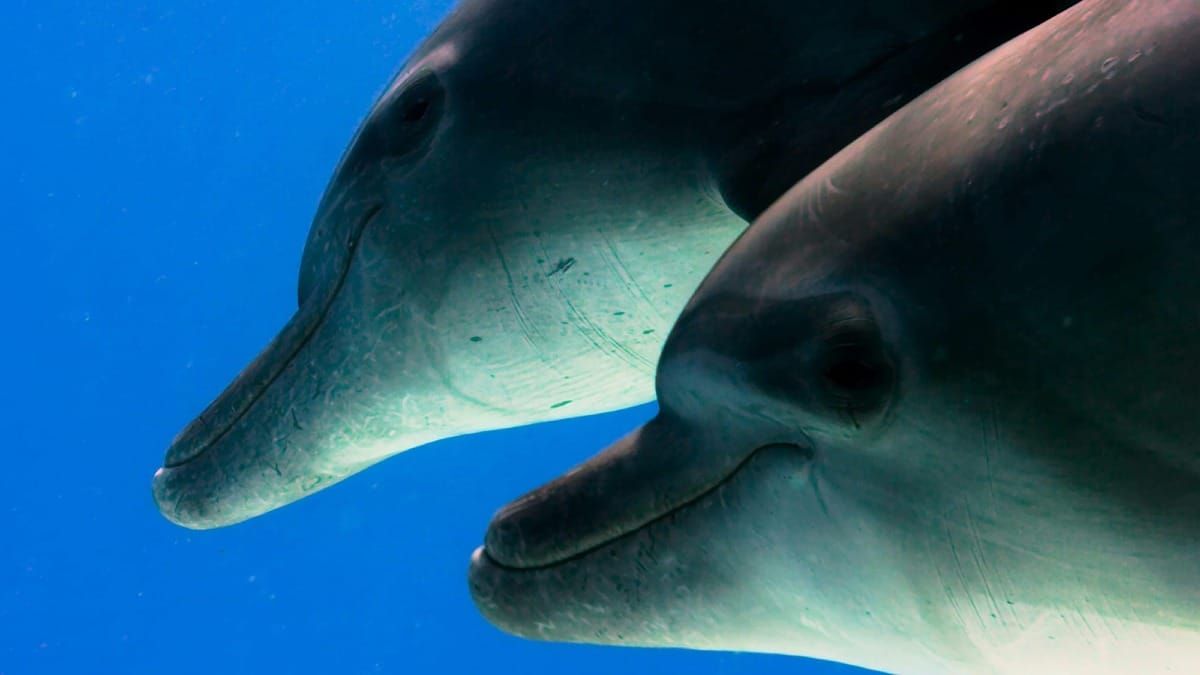
On the morning of December 30, 1991, a marine biologist named Dagmar Fertl observed a bottlenose dolphin feeding on a school of striped mullet off the coast of Texas. After circling the fish, the dolphin plunged and blew a burst of bubbles. Surrounded by spheres of air, the startled mullet reacted by rising to the surface in a tight ball, conveniently served up for a bite.
Apparently it was no fluke; the dolphin repeated the maneuver five times, showing mastery of a foraging technique never before recorded.
How did the dolphin discover that bursts of bubbles could be used like a net? From a practical standpoint, bubbles have nothing to do with foraging. But bubble-blowing is quite common in a different context. When playing, dolphins blow bubbles one at a time and watch them split and join. They chase and bite them as they surface. Using their blow holes, they form perfect rings of air through which they pass the bubbles made with their beaks; they share them with one another, evanescent gifts.
The dolphin’s initial recognition that bubbles could be enlisted for foraging was likely serendipitous, inspired by accidental encounters with fish, keenly observed and refined by applying years of practice to an entirely separate domain.
Play has beguiled and befuddled scientists for centuries. The fact that play is ubiquitous—documented in species ranging from spiders and crustaceans to birds and primates—has convinced researchers that play must be important. Yet explanations for play have proven elusive even within our own species.
I believe the problem is in the framing of the question, the quest to discern a purpose. Loosely borrowing from Kant’s account of aesthetics, I am convinced that play is purposefully purposeless. The imagination is unclutched.
Lifelong play is unusual in animals. Dolphins, though, never stop playing. That may explain why they are also unusually creative throughout their lives and able to excel in situations that might confound other creatures. In captivity, researchers have observed dolphins baiting birds with dead squid and coaxing an eel from a crevice by prodding it with the poisonous spines of a scorpion fish. In the wild, dolphins have solved the problem of protecting their sensitive beaks while searching the ocean floor for prey by fitting sponges over their rostrum like a glove.
Play is purposefully purposeless. The imagination is unclutched.
How did they learn such behaviors? Again, play seems the most parsimonious explanation. Play provides practice at manipulating objects. More importantly, play prepares the dolphin to manipulate categories. In play, it’s perfectly natural to imagine a sea sponge could be a beak cushion.
What’s compelling about dolphins’ interactions with sponges is not that they use tools like humans—that they should be acclaimed for resembling us—but rather that sponging is contingent, that play remains primary. Play is how dolphins get things done. We humans might learn from this.
Although dolphins fight, many potential disputes are preemptively resolved by playing out scenarios before disagreement can arise. In humankind, too, social play provides children with the capacity to anticipate consequences. Children obtain a store of experiences in the relatively safe space of pretense. The experiences can inform future actions with awareness of how they’ll be interpreted. But because dolphins never stop playing, their experiences remain fresh and relevant.
The animal psychologist Stanley Kuczaj and his colleagues spent more than five years meticulously cataloging the behaviors of captive dolphins and found that calves were more likely than adults to come up with novel play behaviors—but adults were more likely to imitate the play behaviors of calves than of other adults. In dolphin populations, imitation is the primary means of cultural transmission. Calves encourage adults to play, inform their play regimen, and lead the way in adaptation and innovation.
Grownup humans were once willing to learn from children, too. In the northwestern Pontic region of Europe, archaeologists have found small ceramic vessels shaped like animals. Featuring holes that could have fit axles, the vessels appear to have been wheeled. The miniatures date to the middle of the fourth millennium BCE, when grain was transported by cattle-drawn sledge. Wheeled wagons would not appear for several centuries.
The archaeologist Felix Riede and colleagues speculate that the miniatures were toys and claim that “inquisitive and entrepreneurial children and adolescents” were plausibly responsible for connecting playthings to agriculture. Their arguments are supported by ethnographic studies comparing cultures that have innovated and adapted and those that haven’t. In the former, toy versions of tools and weapons are far more common.
Like dolphin calves, human children naively discover degrees of freedom in their parents’ environment, either on their own or in play with their elders. In some cases, those degrees of freedom have been directed toward innovation.
Confronted by a complex of novel problems, the world needs innovation guided by the free play of the imagination. If we’re going to get serious about the polycrisis, we have to act more like bottlenose dolphins.
This story originally appeared in Issue No. 02 of Southlands, and is adapted from A Field Guide For More-Than-Human Governance, forthcoming from the Berggruen Press, a book that guides readers to observe—and learn from—self-regulation and self-organization among nonhuman species. Pre-order your copy now.
Title photo by Oleksandr Sushko (Creative Commons).