
Our second issue, PUBLIC/PRIVATE is now shipping! Over the coming weeks, we'll be publishing new stories from the issue on Wednesdays or Thursdays. Not every story will become available to read for free, so if you'd like to access the full issue, you can buy a copy in our shop or subscribe.
“We hung signs last year that say ‘Trespassers will be shot, survivors will be prosecuted.’”
He chuckled as he re-tucked his salmon-pink polo into his pleated khakis. He was part of a private land trust that had closed several wild, sparkling miles of the Nantahala River for the pleasures of the dues-paying members of its rod and gun club. Maybe this scruffy young guide at an Asheville fly shop would ask him, no, beg him for permission to fish it. Plead with him for a chance to guide just one of his members, so I could see the majesty of this section of river reserved for the elite of Raleigh and Charleston. What I wanted to do was cuss him out of the store, call him a carpetbagger, let him know that “wilderness is not a luxury but a necessity,” as Abbey put it. But rent was due. So I gave my best customer-service smile, yessir’d him, nosir’d him, and sent him down the road with a selection of flies I hoped would not solicit even a sniff from one of his precious “private” trout.
I was 24 at the time, back in North Carolina after five summers guiding in Montana and Alaska, where I had experienced vast expanses of public land—wildness unlike anything I had known in my childhood trespassing on farmland in Virginia or my college years exploring the Blue Ridge Mountains outside of Asheville. I had lived and worked with self-proclaimed dirtbags who turned me on to books about ecoterrorism and bleeding-heart environmentalists. With them, I came to see wild spaces as a birthright—a right that I must loudly assert to maintain.
I fished waters churning with salmon, raced eagles to the best holes, and rowed down glacial blue rivers whose remoteness made me feel as though I was the last person on earth. But I longed for the humid summers and ancient mountains of Southern Appalachia. Now, upon moving back to North Carolina, I was met with a sadness so deep I was almost unaware of it. I was in a vast region of privately held land, pocked with sections of national forest and public game lands. Havens. This sadness drummed softly inside me, building into a crescendo of anger when I came across yellow “POSTED” signs on my favorite creek or saw a lot being graded for Dollar General on my way to the river. In the home I’d longed for, those little pockets of wild were commodities—their existence a privilege.
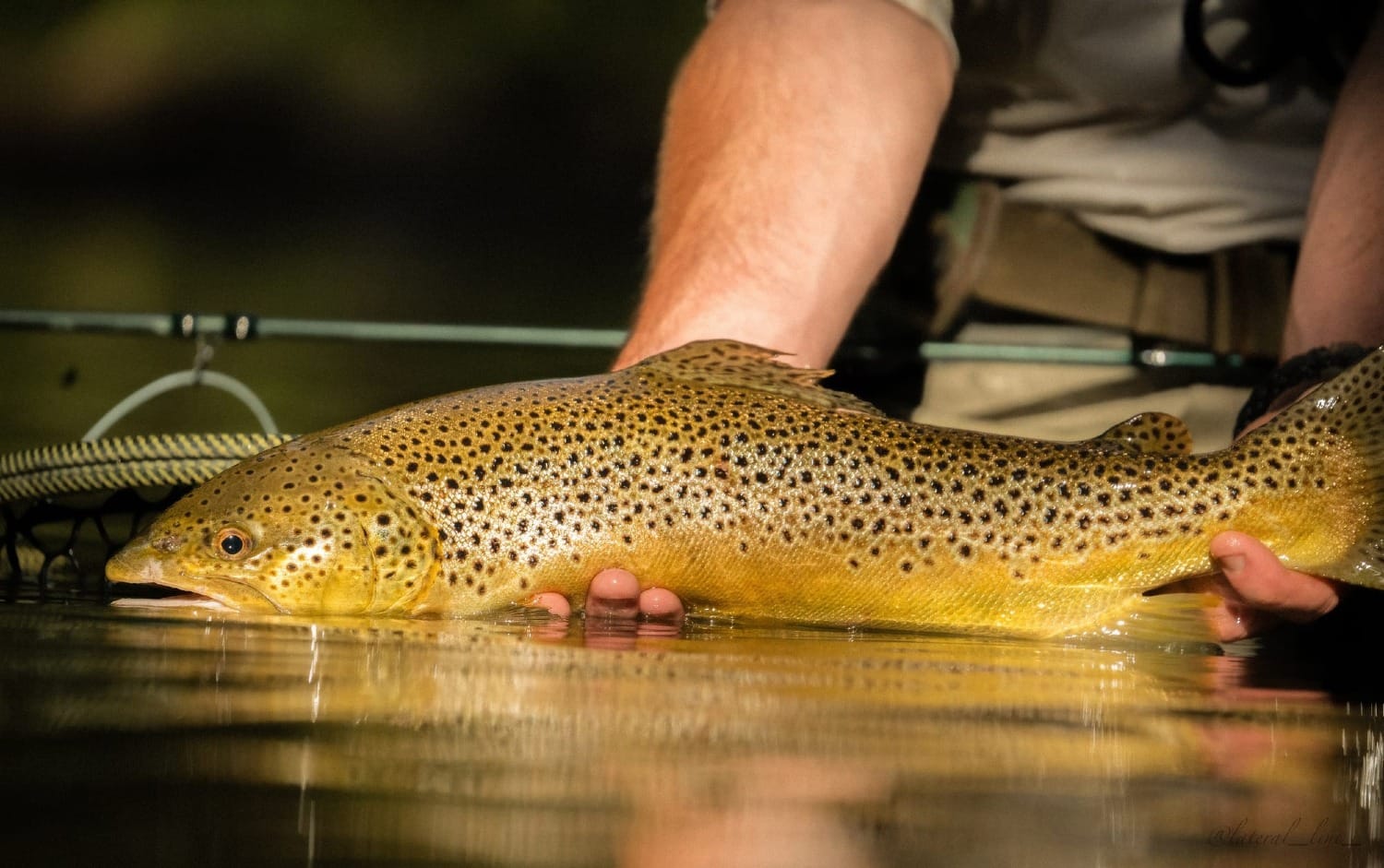
In the three years since, I’ve kept returning to the river as a guide. It’s a way that I can share the mountain creeks that I love and remind myself that this place is still wild. On a warm late September morning I met with three other guides and a group of eight women in the parking lot of a burger joint called Jukebox Junction—the last place to get phone service before we wound our way up a two-lane road to our fishing grounds. The group ranged from their late forties to early seventies. Decades before, one of them had invited a few friends hiking, then next time a few more, until the snowball grew. “This year we wanted to try something new,” a woman named Kathy told me.
As they donned waders, she asked, “Which one of you has been guiding the longest?” When she got her answer, another jokingly said, “I want to catch the most, so I’m coming with you.” Eyes rolled. “Michelle’s one of the competitive ones," an older member of the group said. “Last year she picked a hike so steep a few of us couldn’t make it to the top.” Someone else chimed in: “You just wanted to get back to the hot tub at the Airbnb.”
I led the group up a winding foot path beneath towering hemlocks and past neatly kept cedar-shake cottages. We reached the river, which was no more than a creek this far upstream. A half mile of stocked water that tumbles carelessly, taking respite in long pools before continuing its erratic journey. We veered off the path, and the group followed me down a steep eight-foot staircase made of boulders hauled from the river. The stairs land at a series of pools, each framed by a wide cobble beach on one side and a head-high cutbank formed by recent flooding on the other. The steps are just wide enough that an experienced flycaster could hit the far bank while keeping their feet dry. Four anglers can line up to fish each pool without tangling lines, gazing into the swirling chest-deep waters and seeing the sleek gray forms of rainbow trout holding in the seams.
I have always loved that nature demands my presence in a gentle yet unwavering way. When I am casting to a rising fish, I must give myself wholly to the moment. I wanted to help this group leave what they’d brought with them at the top of the riverside staircase and find meaning from a place that I found so special. The solitude we found ensured everyone could revel in their inexperience. No one was stuck fishing second-class water because the spot their guide wanted to take them to was occupied. No one had to abuse their well-loved, well-used joints to walk down steep banks or over boulders to reach a quiet hole.
Not every stretch of river is so forgiving.
“He could be the only one I catch all day and I’ll be happy,” Kathy said as she stared into my net at her first fish—a fourteen-inch slate-gray rainbow. As I showed her how to turn his head into the current to revive him from the fight, I heard Michelle cackle from upstream. She had become so focused that she hadn’t realized her wading boot had come untied and slipped off. “Quick,” she said, “someone get a picture of me holding it like it’s a fish I caught.”
As I sat on my tailgate and waved the group off, I felt divided. I wondered what that 24-four-year-old dirtbag would say if I told him I guide private water.
But now I must come clean: this perfect stretch of river is private. It flows through a camp owned by the Episcopal Church. Access through the property is granted to a single outfitter in exchange for stocking the stream and a per-client payment that we receive as a “rod fee.”
As I’ve settled into guiding in North Carolina, private water has become my bread and butter. The harvest season for stocked trout begins the first Saturday in June, and by the end of the month the stocked streams are picked clean. In the heat of July, the wild trout rivers become too low and warm to fish, and private sections of river become one of the few places a guide can take their clients for a real shot at fish. These are usually remote stretches of a stream where the property on both banks is under the same ownership. “No Trespassing" signs hang on the upstream and downstream property lines. These agreements create consistency for guides in a region of pressured fisheries. Still, local anglers wonder if a vicious cycle has been formed, in which they lose access with every handshake deal between outfitter and landowner.
As I sat on my tailgate and waved the group off, I felt divided. I had given these women a day that I wasn’t sure I could have on the public water upstream. Still, they were visitors in my community. I thought of my friends who grew up along the banks of this stretch who may never get to fish it. I wondered what that 24-four-year-old dirtbag would say if I told him I guide private water. He might point out that before I was a guide, I was an angler. Remind me that when I fish on my own, I find myself driving dusty Forest Service roads, pushing deeper into tight hollows, searching out places where I can avoid the gaze of land managers in pastel polos. Maybe I would tell him that private stretches are tools in my toolbox. I don’t know if he’d think that’s the right answer, but I know he’d realize that I can use these stretches to help folks find that spark that drew us to the river in the first place. Private or not, people have to find the rivers, and love the rivers, if we want to keep them wild.
This story originally appeared in Issue No. 02 of Southlands.